Monday, June 15, 2009

Donahue’s in St. Isidore’s Cemetery, Osman-Meeme, Wisconsin

Our Donahue ancestors and relatives for the most part lived a farming life in Manitowoc County, Wisconsin. When attempting to gather any information on the families the sources are found in two different areas, the City of Manitowoc where the county courthouse is located and the farming communities to the south west, between Manitowoc and Sheboygan.

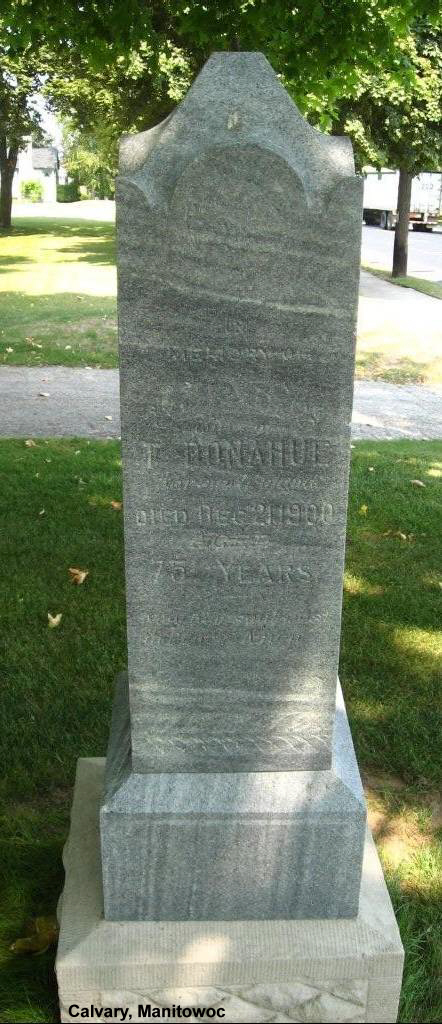
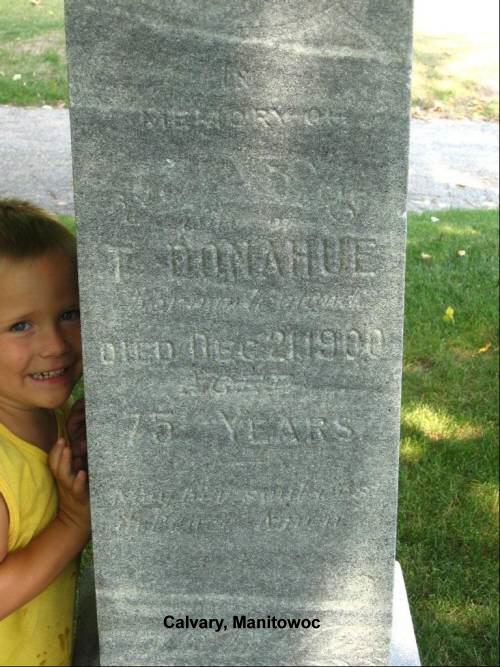
This record deals with what family information has been found on the internet and primarily from one valuable online source for Manitowoc Genealogy, http://www.2manitowoc.com/. This web-page has provided a wealth of information and is probably the best I have encountered regarding our family history. As of now what is reflected here deals with the records regarding the cemetery of St. Isidore’s Catholic Church in Meeme where our grandmother Mary Ellen Donahue was born and raised. Our Great-Grandparents, Thomas and Mary Donahue are not buried in this cemetery however. After selling the Donahue farm near the end of the 19th century they purchased a small home in Manitowoc where they lived out the rest of their lives. They were buried in the Calvary Catholic cemetery in the town of Manitowoc. The web source mentioned here has pictures of the Donahue grave marker posted on their web-page, one of very few pictures they post, and the following links will take you to those pictures. A small boy is captured in one photo and he remains unidentified.

http://www.2manitowoc.com/01/43donahuemary.jpg
http://www.2manitowoc.com/01/43donahuemary2.jpg

When one attempts to gather information on any family of the 1800’s the most accessible and credible source is always the records of the local churches that the ancestors attended. That has proved to be the case for both of our Irish ancestral families, the McGinnis’s of Chatham, New Brunswick and the Donahue’s of Manitowoc County, Wisconsin. In New Brunswick it is St. Michael’s of Chatham and in Wisconsin it is St. Isidore’s of Meeme or Osman. Meeme is where the Donahue home was located for most records and Osman, but a few miles away, is where the church was located. Only the cemetery remains an active part of a new parish near by. The old church and school have apparently been torn down or sold off. The Meeme-Osman area of Manitowoc County is about 15 miles to the southwest of the city of Manitowoc and but 3 miles to the west of Interstate 43 that runs north from Milwaukee to Green Bay, Wisconsin, following the Lake Michigan shore line.


The following short description and photo regarding St. Isidore’s is from the wonderful source mentioned above: http://www.2manitowoc.com/


ST. ISIDORE CATHOLIC CEMETERY

Meeme Township, Manitowoc Co., Wisconsin
Location: Located on the east side of Highway 42 in Osman, directly in back of the church and school. The cemetery is well kept but does have large areas where there are no longer any markers. Copied Saturday and Sunday, August 20 and 21, 1977 by Marcie Baer, a member of the MCOCS. Earliest remaining stone is 1856.


By accessing a list on the Manitowoc web-site that transcribes the names and dates of all the headstones for the St. Isidore’s parish cemetery the Donahue’s of Manitowoc County are represented. Several graves of various ancestral family members are easily identified and can be traced on our family tree. A few other Donahue’s cannot be connected to our line but I strongly suspect that someday a connection might be proven.

Below is the list which appears to be the recorded Grave Transcriptions integrated somehow with actual parish records. The combination of data has led to some discrepancies between the two sources and they are not sorted out here. Actual relationships to our Great-Grandfather Thomas Donahue have been added after collaboration with other Donahue family history researchers. This is a combined effort of me, Molly McGinnis Wright of Dundee, Oregon, Sharon Donahue Moniowczak of Bark River, Michigan and Floyd Billings Jr., of Provo, Utah.

As is common with many ancestral surnames, the Donahue name also emerges from past records with several different spellings. Some variants are “Donaghue with or without the “O” in front, Donahoe or even Donohoe. O’Donaghue appears to be the most common spelling found in many 19th century records originating in Ireland, but not necessarily the original version. Many times the spelling is a clerical error and at other times different families adapted their own choice of spelling after they immigrated. What survives in the records of St. Isidore’s may be attributed to both reasons. We have no definite reasoning to apply to what the records reflect today.

Sharon Donahue Moniowczak and her brother, Richard Donahue, have compiled more extensive Church, Cemetery and even County records that I will attempt to scan and post at a future date. Their effort really needs to be properly recognized and presented as a stand alone posting. They put forth a considerable effort to gather all they did and it is greatly appreciated by the rest of us.

As always, I can only suggest that if you want to make any sense out of all of this that you download a Donahue family tree that I have uploaded and stored on Google Documents. That tree can be found at the following link but you will need to log into Google to view it-
http://docs.google.com/fileview?id=F.2d2eb78f-c53a-4948-b2eb-22fda413d199&hl=en&pli=1

One abbreviation might need explaining, i.e. “OSSW” has the meaning “On the same stone with”.


Michael Donahue-
Grave Transcription-
Michael, Son of, T.& M.A. Donahoe, Born, Sept. 20, 1885, Died Febr. 16, 1886,
Budded on earth, in bloom in heaven., ossw: 1885-1886

Relationship to Thomas Donahue Sr.:
Grandson of Thomas Donahue Sr. and Mary McKeough Donahue, son of Thomas Donahue Jr.

For my generation, this would be a son of our Grand-Uncle, Thomas Donahue Jr. Relationship tables do not actually assign a relationship of the son to my current generation. The tables stop assigning at the level of the father of this Michael Donahue.

Thomas Donahue-
Grave Transcription-
Thomas Donahoe, Born June 9, 1857, Died, March 14, 1887 (War vet flag holder)
Footstone: T.D.
1857-1887

The Church Record for the burial states:
Thomas Donahue, no stone, d. 14 Mar. 1887, age 29 yrs., husband of Maria Anna Donahue (from records of St. Isidore Cath. ch. bk.1 p.201)

Relationship to Thomas Donahue Sr.:
Son of Thomas and Mary McKeough Donahue and an older brother of our Grandmother, Mary Ellen.
This is the father of Michael Donahue as explained in the first Grave Transcription above and a Granduncle to today’s generation.


Patrick Donahue-
Grave Transcription-
Patrick Donahue, ossw: Wife, Honorah

The Church Record for the burial states:
Patrick Donahue, d. 9 Jan. 1917, age 88 yrs, (from records of St. Isidore Cath. ch. bk.1 p.220)

Relationship to Thomas Donahue Sr.:
Brother. Brother Patrick emigrated from Ireland in the mid-1850’s after his brother Thomas had begun farming. Most likely Thomas promoted if not financed his younger brother to help him immigrate and begin his life of farming nearby.

Hanorah Donahue-
Grave Transcription-
Hanorah, wife of P. Donahue, Died June 20, 1896, Aged 63 years, a native of Roscommon Ire., ossw: Husband, Patrick1833-1896


The Church Record for the burial states:
Hanora Donahue, d. 22 June 1896 (from records of St. Isidore Cath. ch. bk.1 p.206)

Relationship to Thomas Donahue Sr.:
Sister-in-law, wife of Brother Patrick.

Hanorah’s maiden name was Luby. She married Patrick Donahue about 1858 in Manitowoc County. No trace of her family line has been found to date. She also was an immigrant from Roscommon in Ireland, an area just to the north of Galway where the Donahue’s originated.

John Donahue-
Grave Transcription-
John, Son of, Patrick & Honorah, Donahue, Died, June 23, 1897, Age 34 years.
1862 or 1863-1897

The Church Record for the burial states:
John Donahue, d. 25 June 1897, age 30 yrs (from records of St. Isidore Cath. ch. bk.1 p.207)

Relationship to Thomas Donahue Sr.:
Nephew, son of Brother Patrick and Hanorah.

To the current generation this is a “first cousin, twice removed”. Removed in essence only indicates the individual was of another generation. Our cousin Tommie of Florence is a first cousin once removed. I constantly have to refer to the following definition each time I come across the relationship in our family data.


Patrick Donahue-

The Church Record for the burial of Patrick Donahue provides the following:
Patrick Donahue, d. 7 Dec. 1899, age 22 yrs, par. John Donahue and Margaret Fitzgerald (from records of St. Isidore Cath. ch. bk.1 p.209)
1877-1899

The following notation was inserted into the internet list. It was taken from a local German language newspaper. The Irish and the German farmers of the region lived side by side and the families intermarried as in the case of Margaret Donahue, our Grandmother’s sister that married an Arnold Siehrs. They preserved their separate cultures but in essence they were all proud members of the local community.

From Der Nord Westen, 14 Dec. 1899:

Patrick Donahue of Meeme, who was working in a lumber camp near Menominee, Michigan on Thurs. last week, was hit by a falling tree and killed. His body was brought to Meeme for burial. He was 22-1/2 yrs. old.

Relationship to Thomas Donahue Sr.:
Grandson, son of John Donahue-
To the current generation, he also would be a first cousin, once removed.

Removed-

When the word "removed" is used to describe a relationship, it indicates that the two people are from different generations. You and your first cousins are in the same generation (two generations younger than your grandparents), so the word "removed" is not used to describe your relationship.

The term "once removed" mean that there is a difference of one generation. For example, your mother's first cousin is your first cousin, once removed. This is because your mother's first cousin is one generation younger than your grandparents and you are two generations younger than your grandparents. This one-generation difference equals "once removed."

Twice removed means that there is a two-generation difference. You are two generations younger than a first cousin of your grandmother, so you and your grandmother's first cousin are first cousins, twice removed.

John Donahue-

The Church Record for the burial of John Donahue states:
John Donahue, no stone, d. 1 Oct. 1912, age 62 (from records of St. Isidore Cath. ch. bk.1 p.217)
1850-1912

Relationship to Thomas Donahue Sr.:
Son of Thomas and Mary McKeough Donahue.
A Granduncle to today’s generation.

One of the few if not the only child of Thomas and Mary that lived his life out in the Meeme or Osman areas.

Ida Donahue-
The Church Record for the burial of Ida states:
Ida Donahue, no stone, d. 18 July 1911, age 20 yrs, par. John Donahue and Margaret Fitzgerald, from records of St. Isidore Cath. ch. bk.1 p.216)
1881-1911

Relationship to Thomas Donahue Sr.:
Granddaughter, daughter of John Donahue and Margaret Fitzgerald

William Donahue-
The Church Record for the burial of William Donahue states:
William Donahue, no stone, d. 30 Nov. 1906, age 19 yrs (from records of St. Isidore Cath. ch. bk.1 p.213)
1887-1906

Relationship to Thomas Donahue Sr.:
Grandson, son of John Donahue


The Donohue’s within the record that follow appear not to be related. Molly McGinnis has a very curious mind and is very good at bringing up possibilities and some of her notations are included here for future reference.

Donahue-
Grave Transcription-
Mary Donohue, daughter of, Patrick & Mary HAYES, and wife of Michael Donohue, Born March 20, 1818, Died Oct. 7, 1876, ossw: 1818-1876

Relationship to Thomas Donahue Sr.:
Unknown relationship. Most likely not related.

Molly’s comment:

Another puzzle. In 1860 in Meeme, there’s a Charles & Margaret in their household as: John Hayes, Michael Donahue (age 50 born Ire), Jeremiah Donahue (age 15 born Ire), and Mary Donahue (age 8 born Pennsylvania). It’s interesting that a John Hayes is listed as he could be a brother-in-law to this Michael Donahue if he’s the Michael married to Mary. However, the only Mary listed is an 8 year old. Notice again, that young Mary was born in Pennsylvania as the earliest Jeremiah Donahue children were. This is looked like a good possibility as John Hayes is listed and supposedly Mary Donohue was the daughter of Patrick & Mary Hayes—they may have been siblings. But where’s Mary born 1818? Could they have not gotten married until after 1860? Perhaps this Michael had been a widower?

Another possibility, is in 1870 in Plymouth, Sheboygan Co. There’s a Michael born 1807 Ire, Mary born 1820 Ire, along with a Mary 16, Patrick 14 and Dennis 12. Since the Jeremiah group was in Sheboygan Co, there may be a connection there, too. Hope Floyd has some input for this one.

My comment:
When Brother Patrick arrived from Ireland, he undoubtedly traveled with another sibling, Mary Donahue. Mary appears in the records at about the same time that Patrick does suggesting the older brother Thomas may have provided the means for both of his siblings to immigrate. Perhaps there were other family members in Ireland that did not come to the U.S. leaving the possibility that we may have relatives in Ireland even today. That remains to be proven.


Mary Donahue, again, a sister of our Great-Grandfather, married one Arnold Siehrs as mentioned earlier. The next five descriptions are of Mary’s family. The children of Mary and Arnold of course would be distant cousins to our current generation.

Arnold Siehrs-
Grave Transcription-
Arnold Siehrs, Dec. 25, 1866, Apr.8, 1939
1866-1939

Relationship to Thomas Donahue Sr.:
Nephew, son of Mary Donahue Siehrs and husband Arnold

Mary Siehrs-
Grave Transcription-
Mary Siehrs, Dec. 25, 1819, Apr. 30, 1915, next to Large Siehrs monument,
1819-1915

Relationship to Thomas Donahue Sr.:
Sister, Mary Donahue Siehrs.
Also next to Large Siehrs monument


Arnold Siehrs-

Grave Transcription-
Arnold Siehrs, Dec. 13, 1817, Jan. 3, 1896, next to:
1817-1896

The Church Record for the burial states:
Arnold Siehrs, d. 6 Jan. 1896, age 73 yrs. (from records of St. Isidore Cath. ch. bk.1 p.206)

Relationship to Thomas Donahue Sr.:
Brother-In-Law , Husband of sister Mary Donahue Siehrs
John Siehrs-
Grave Transcription-
John, Sept. 26, 1863, Oct. 13, 1934,ossw:
1863-1934

John Siehrs-

Grave Transcription-
John, Sept. 26, 1863, Oct. 13, 1934,ossw:

1863-1934

Relationship to Thomas Donahue Sr.:
Nephew, son of Mary Donahue Siehrs and husband Arnold.

Catherine Siehrs-
Grave Transcription-
Catherine, July 31, 1873, May 12, 1941
1873-1941

Relationship to Thomas Donahue Sr.:
Wife of Nephew, John Siehrs


Donahue’s- Related or not ?

Another Donahue Family is at rest in St. Isidore's and collaboration with others results in no connection to our Donahue’s. Some comments that passed between us while attempting to sort all this out are included here.

Family Marker Description-
Large stone-family name only. Separate stones read:

Katherine, 1856-1928, next to:
Nellie, Apr. 9, 1865, Apr. 23, 1913, next to:
Katharine, Sept. 15, 1819, Oct. 6, 1897, next to:
Jeremiah, Jan. 6, 1822, Dec. 20, 1909

Relationship of this family to Thomas Donahue Sr.:
Unknown, if any

Molly’s comment:
This is Jeremiah & Catherine Donahue with two of their daughters. Again, how are they connected to Thomas?

Floyd’s input:

This refers to a family that lived mostly in Sheboygan County. Much information about them is available in the Sheboygan county website. The mother's maiden name was Hayes and that is presumably what made for a connection to St. Isidore.

Church Records reveal the following detail of the family:
Jeremia Donahue, d. 23 Dec. 1909 (was buried at St. Michaels, Mitchell, Wis. moved to St. Isidore Cemetery, 3 Oct. 1911 (from records of St. Isidore Cath. ch. bk.1 p.216)
1822-1909

Molly’s comment:

Jeremiah Donahue was the husband of Catherine Donahue listed in #11. I’m hoping that Floyd has the connection to Thomas, if there is one to be had. Jeremiah & Catherine are in Plymouth, Sheboygan Co. in 1860; Greenbush, Sheboygan Co. in 1870; Mitchell, Sheboygan Co. 1880, 1895; & Jeremiah is living with son, Bart (Bartholomew) in 1900 also in Mitchell. Jeremiah immigrated in 1846 and was born in Ireland in Jan 1822 according to the 1900 census. Remember Floyd sent us a copy of a photo of one of his family with “relatives in Sheboygan”. Could these relatives possibly be connected to the Jeremiah Donahue family? Jeremiah & Catherine had a whole slew of kids: Johanna, Timothy, Eliza,

Catherine Donahue, d. 8 Oct. 1897, age 78 yrs (from records of St. Isidore Cath. ch. bk.1 p.207)
1819-1897

Helena (Nellie) Donahue, d. 23 Apr. 1913, age 47 yrs, from records of St. Isidore Cath. ch. bk.1 p.218)
1866-1913

Another different family:

Grave Transcription-

Mikey, son of Cors & Mary Donohoe, Born Sept. 25, 1863, Died Aug.17, 1873
1863-1873
:

Relationship to Thomas Donahue Sr.
Unknown, if any

Floyd’s input:

Mikey is presumably a son of Cornelius & Mary Donahue who lived in Manitowoc 3rd ward for a short time around 1880. Cornelius was a railroad engineer.


Tuesday, June 9, 2009

McGinnis Family Records, St. Michael's Parish, Chatham, New Brunswick

James McGinnis Sr.
About age 35


Copied from a photo taken in Chicago about the time
of the marriage of James and Mary Ellen Donahue in 1883


The following inserted pages are microfilm photo copies of the actual records of St. Michael's Parish in Chatham, New Brunswick or some adjacent parish. Some are extremely difficult to read due to the penmanship of various priests as they recorded the dates they gave the Sacraments of Baptism and Marriage to their many parishoners.

The Drouin Genealogical Institute of Quebec took on the task of microfilming all the church records of the various Catholic parishes administered out of Quebec City which is a considerable amount of records. The area involved in the task essentially covered every parish in the provinces of Quebec, Prince Edward Island, New Brunswick and Nova Scotia, all under the auspices of the presiding Archbishop or Cardinal residing in Quebec City or Montreal. The effort begun in the 1940's was primarily meant to record French genealogy records but as is evident the task encompassed all parishes, French or English speaking. Since the Maritime Provinces, unlike Quebec of course, are primarily English speaking with many sizeable pockets of French culture it was determined that all records would be filmed in order to capture the data of all the French families.

Thus many if not most of the records of our Irish Canadian ancestors came to be preserved forever and through the magic of the computer age these images are all indexed and available for easy access over the Internet. To me personally this source has been a treasure and what you view here is primarily data of our primary interests. Many other pages involving the families that various ancestors married into have also been downloaded and saved for future reference. Tracing Godparents has been a useful tool in establishing family connections and for that reason alone all these records have been a valuable source to help piece together all that is known today.

You will notice that some entries are purposely obscured or covered over for some reason. Most likely this was done for reasons of privacy but just how that was established is yet to be discovered. It occurs often through out the Drouin collection. Another common practice during the filming was to insert a loose page of information into the record which resulted in some entries being covered over. I later discovered that these pages were filmed twice so that all data was eventually filmed.

To enlarge the view simply double-click on the image.


Baptism Record of James McGinnis
September 15, 1847

Chatham, Northumberland County, New Brunswick


The record for James is on the right side of the image, third entry from the top


Reverend John Sweeney
1821-1901
Baptising Priest of James McGinnis
Father Sweeney was the second priest to serve the
parishinors of St. Michael's after it's establishment in 1839,
three years after our Great Grandfather John McGinnis
arrived from Ireland


Baptism Record for John McGinnis Jr.
August 26, 1849
Third child of John McGinnis,
Second child of Margaret McCarron
The record for John is on the left of the image,
fourth entry from the top


Baptism Record for Patrick McGinnis
August 3, 1845


First born child of John McGinnis Sr. Mother is Mary Buchanan. She apparently died shortly after the birth for no further record can be found for her. This is a stepson of Margaret McCarron that obviously raised Patrick as her own son.
The record for Patrick can be found scrawled at the bottom right of the image.


Marriage of Arthur McGinnis Sr.
October 30, 1878

Younger brother of James McGinnis Sr.
Arthur married Mary Margaret Buckley.
Both are buried side by side in Calvary Cemetery in Seattle.
The record entry is at the top left.


Marriage of Sarah McGinnis and
Patrick Fitzpatrick
September 17, 1884

Only sister of James McGinnis Sr. and both are also buried side by side in Calvary Cemetery in Seattle.
The record entry is at the bottom right.


Friday, June 5, 2009

Cousin Mary Mills, A Milkmaid, A Terrific Baker, A Wonderful Memory-

To expand on some memories of Mary and Charlie Mills, what comes to mind more than anything is the lasting memory of Mary’s baking skills. She must have loved to bake and I can only say thank the Lord she did.

Anyone visiting Mary and Charlie was always offered a cup of tea and a sample of the latest from her oven. Be it cake, cookies or my very favorite her fresh baked biscuits as she called them. A biscuit was a large dinner sized bread roll, split open and covered with a generous smattering of butter. For those too young for a cup of tea, fresh milk from the days milking was the offer.

The one year we lived on the farm in Florence, from the summer of 1949 through the fall of 1950, was a special time for me. It was a totally different environment going from living in a city to living on a farm and along with the summer vacations, living on the farm where Mother was born and raised brings back the happiest memories of my young life.

Mary apparently enjoyed having children next door and when ever we could make an excuse to visit Mary and Charlie we would make a bee-line across the small field between the two houses to approach the back door knowing full well a baked treat of some sort was in store. Early on the excuse became “can we go over to Mary’s and read today’s funnies” in the morning edition of the Seattle Post Intelligencer, a subscription that Mary and Charlie always had delivered to the front gate daily. We were always met with a smile and the anticipated offer of would you like a piece of cake or a biscuit as the well read daily paper was retrieved from the top of a small table, just large enough to spread out the paper and corral the treat that Mary retrieved from her small pantry off the kitchen. Such a small narrow space with but a small sink and lined with shelves where she stored all her baking supplies and utensils. Not large enough for cooking for certain so her mixing and preparation was always performed at the large oil-cloth covered kitchen table.

The funnies retrieved and the treat served a quiet time came upon the room as the funnies were absorbed. Occasional conversation would arise as Mary, or Charlie from his usual chair beside the stove, might ask a question about school or how Mother and/or Johnnie might be that day. Always a pleasant way, to spend the time after jumping down from the school bus that delivered us home each day and the time that milking began about four to five PM. But the underlying motivation was always to taste the wonderful product of Mary’s daily baking. The funnies, well they were important, but not as enjoyable the daily treat.

Mary and Charlie might have had a sweet tooth, for fresh baked goods were always at hand and if not baked by Mary, they might have been purchased at the front gate from the bakery delivery truck that would sound it’s horn at the road twice a week. Mary did not bake loaves of bread, only her wonderful bread biscuits, so their sliced bread was always purchased off the truck as he ran his route every day to all the outlying farms in the area.

What follows is taken from something I wrote several years ago about the wonderful memory of the bakery truck. It really was a special event to witness for nothing like this service was ever experienced while living in the city. It was a unique experience and the memory has always remained in a special and pleasant segment of my memory.


Golden Rule Bakery Truck

This was really something special. This was a bakery on wheels from Seattle with routes through the more remote areas of the Puget Sound area. The particular route we were on would bring the service to our door maybe two or three times a week but I could have dealt with it every day. When this panel truck sounded its familiar horn at the front gate of Mary Mills next door it was always an exciting time. I would rush to the road and run the fifty yards or so in order to be there, as Mary would come from the front door of the house and head towards gate at the roadside. As she approached the truck with the script written sign on the side panels proudly stating the name of the company,


then the driver would swing open the back doors of the truck and out would rush the most wonderful smells of fresh baked goods of all kinds. I can still recall those wonderful mouth watering smells to this day and no bakery in my lifetime has ever matched the wonderful memory of this special truck. The bakery goods of all kinds were all in neat packages from bread, to rolls to cookies, pastries and cakes all efficiently packed in tight from floor to roof , from front to back all placed in specially built shelves that the driver would pull out for one to see his luscious products. But the lingering smell was most wonderful on a warm summer morning after the sun had been beating on the steel sides and roof of the truck allowing the aroma of fresh baked goods to build up and concentrate to suddenly be released as the doors were first opened. It was magnificent ambrosia to a young one from the city.

It was probably a purchase by Mother or Uncle John that first introduced me to the pastry delight called a “Bear Claw”. What a wonderful treat this was for someone from the city where such items were a real luxury while growing up in Bremerton. I could never get enough of them and almost every summer day I would hope that today the truck would be stopping at our gate and Bear Claws would once again be purchased. If not a Bear Claw then perhaps something else as sweet and delectable would do just as well but this wish certainly was not fulfilled as much as I would have liked. The driver would only stop at our gate if Mom or Uncle John flagged him down as he reentered the road after pulling away from Mary’s house. Mary Mills was a good customer for the truck stopped faithfully every time for her and if I was within earshot of the unique musical sound of the trucks horn that the driver would proudly blast to announce his arrival at the gate. I would avail myself of every opportunity to be present as the doors were opened on that truck and it was even better than Mary’s kitchen on a baking day.


I missed the farm, Uncle John, the family dogs, Mary and Charlie when we moved back to Bremerton in 1950. Those times on the farm were so very special. Looking back on these times so many years later it is easy to see how Mary especially filled a place in my heart. She became almost a Grandmother figure which is something that never occurred to me early on in life. Only now can I make that connection. Our grandparents were long deceased by the time we were born. I wish the times could be given back.

Wednesday, May 27, 2009

The Cousins Next Door- Ferguson & Mills

Robert Ferguson, Mary Mills holding young Thomas Fountain McGinnis and Charlie Mills at the right,
circa early 1925


(The above photo, and the one of Charlie Mills that follows were provided by Molly McGinnis Wright, saved from her grandparents collection. This group photo serves to verify the identification of the elder gentleman on page 36 of the Album Mary Ellen McGinnis left behind that was never validated as being Robert Ferguson)

Mary Mills and her younger brother Charlie lived on the farm to the east of where Mother grew up in Florence. Neither of them ever married and I never, ever heard a word of anger come from either one of them. Politically or when discussing the ethics of other local citizens, Charlie could become very animated in his discussions, but Mary was always just the opposite. Soft spoken and with very gentle mannerisms. Some of my fondest memories are of these two. The one year we lived on the farm beginning in the summer of 1950 I believe through early fall of 1951 really is the time that my most warm and lasting memories of the two really are traced to.

They were friends, neighbors and relatives all in one. Mary was known to us as “Mamie”. Looking back I look on her almost as if she were my own Grandmother. Since she was 18 years older than Mother, looking back I can see how that came about. By the time I was born, all my grandparents had been long departed. Mamie seemed to fit the bill to me but I never ever expressed that openly. It was just an internal thing with me.

Actually Mother and Mamie were cousins and when tracing the family line, Mother, Mary and Charlie, can be traced back to a common great-grandfather. This patriarch of the McGinnis family has never been formally identified by name or place but it is assumed he was born and died in Ireland, probably in County Monaghan.

We grew up always knowing that Mother and Mary were cousins but just how they were related as second cousins was never explained and only in recent years due to interest in family history have I been able to define the relationship. Granted, perhaps there are other ways through marriage that created the relationship but all available evidence really traces the connection back to one unknown McGinnis great-grandfather of the two, a man whose given name we do not know, a man that most certainly lived his entire life in Ireland.

The following abbreviated family tree and table identifies the relationship of various family members to that one unknown man in Ireland. This connection is what establishes Mary Agnes McGinnis and Mary Mills as Second Cousins to one another. To my generation, the children of Mary Agnes and Charles Jones Sr., we are “Second Cousins Once Removed” to Mary and Charlie and to the unknown McGinnis ancestor from long ago Ireland, we are labeled as “Second Great-Grandchildren” to him.


The McInnis surname in the table is a branch of the McGinnis clan in New Brunswick. This branch comes from another child of the unknown ancestor, a daughter Catherine that married an Andrew McInnis, of Scotch descent, in Nelson, New Brunswick, in the vicinity of Chatham. A McGinnis marrying a McInnis makes looking through old church records a virtual nightmare when first coming across the marriage. No data tracing the McInnis descendants to current times has been found as yet. Another daughter, Mary, married into the Ferguson clan in Chatham which provides the relationship link to Mary and Charlie. In summary, the unknown ancestor had three children that we know of, son John, our great-great grandfather, as well as the two daughters described above. All the known descendants of these three siblings are included in the table.

Mary and Charlie lived on the ten acres of land inherited from their Uncle Robert Ferguson after he died in 1927. They continued tending their small herd of milking cows also left to them and through hard work on both their parts they managed to support themselves up until their deaths in the 1960’s. An album left behind by our grandmother Mary Ellen contains two photos on a page, side by side, of an older gentleman and another photo of Mary. This is what might be considered strong evidence that the gentleman is Robert. Our grandfather James McGinnis and his next door neighbor Robert Ferguson were first cousins. The two purchased the land for their farms, side by side, the very same day and began their life of farming in Florence together in 1891-1892.


Robert Ferguson (1845-1927) and Niece Mary C. Mills (1878- 1968)
Page 36 of the Photo Album Assembled by Mary Ellen McGinnis


Mary and Charlie were born in Chatham, New Brunswick, Canada where all the McGinnis family originated. Mary was born in 1878, Charlie in 1890. Their father Luke Mills married Catherine Ferguson, sister of Robert Ferguson. Catherine and Robert’s mother was Mary McGinnis and all evidence points to the fact that Mary McGinnis was a sister of our great-grandfather, John McGinnis. Difficult to put into words and thus a family tree is inserted here. Begin with the unknown McGinnis and the connection can easily be seen.

Mary and Charlie were but two of seven children with the birth years ranging from 1877 when William Mills was born to Charlie’s birth in 1890. Using census data it can be established that Mary left home in the early 1900’s and traveled to Boston to work as a domestic in homes in and around Boston. Her Boston destination was established through later anecdotal facts passed on to friends in Florence, namely from Ivy Hansen as related to her by her mother-in-law, Stella (sometimes spelled Estella) Hansen. Mary is not in the 1901 Canadian census nor has she been found in the 1900 U.S. census and the 1910 census states she immigrated in 1902. This establishes that she left New Brunswick at about age 24 or 25 when Brother Charlie was around 12 years old. As a rough estimate Mary was probably working in the Boston area as a servant of some sort beginning around 1900 or 1902 through about 1907 or 1908 when she came west to Florence to the farm of Robert Ferguson, her uncle.

Uncle Robert Ferguson had been farming about ten years when Mary left home and was probably well established. A single man, he rather than his sister Catherine Ferguson, now Catherine Mills, far away in Chatham, took on the responsibility for caring for their aging father, John Ferguson. John Ferguson is found in the 1900 Florence census living with his son Robert and his data states he immigrated in 1891 but had been in the States for 8 years meaning he immigrated in 1892. The latter is the most likely year he arrived in Florence for his son was still establishing his farm in 1891 and he probably would not have traveled all that far until some sort of a living accommodation was available.

John Ferguson died in March of 1908 in Florence, at the age of 88. His death certificate indicates a sudden but non-suffering end. From the document: “Cause of Death-Senility” followed with a statement: “He was not sick. Walked outside and came back and sat in a chair and died in a moment. Duration: 0 days.” No pictures of the senior Ferguson exist. His son Robert is buried beside him in the Florence Cemetery.

The facts tend to establish that Mary may have been asked to come west to Florence, assumedly from Boston, to help care for her grandfather whose health may have been failing. If not that reason, certainly the aging Uncle Robert was also soon to be in need of help around the farm and Mary in her late twenties in 1908, still single, may have been encouraged to come west and eventually fall heir to the farm since Robert had no other direct heirs. The exact year Mary arrived in Florence is not known but since she is in the 1910 Florence census the timing of her arrival to care for her grandfather is highly probable making the year she may have arrived in Florence as 1908, perhaps 1907.

Based on the 1930 Florence census data, brother Charlie Mills arrived from Chatham in 1925 to also help out on the farm. Their Uncle Robert died but two years after Charlie came on the scene and presumably the uncle’s health had begun to fail in the early 1920’s meaning more and more work was falling on Mary and she definitely needed help.

Charlie Mills, about 35 years old

Holding Young Thomas Fountain McGinnis (1923-1995)
Tommie probably about a year old (born November 20, 1923) making this photo date to be at least November 1924. Charlie’s 1930 census states he immigrated in 1925. If so then this might be very early 1925 making Tommie just about 14-16 months old. Regardless, this photo of Charlie had to have been taken just about the time he arrived from New Brunswick.

As stated both Charlie and Mary remained on the small farm of ten acres the rest of their lives managing a small dairy herd that I recall was always around ten cows. This was about three or four more than cousin John McGinnis next door always maintained alone.

Mary remained a devout Catholic all of her life and was active in maintenance of various church needs of St. Cecelia’s parish in East Stanwood that fell on the members of the Altar Society, a traditionally woman’s role in any Catholic parish. During our stays on the farm Mother did not always attend Mass on Sundays and many times Mary would take Don and me in tow and be off to Mass with us on foot to ensure that we completed our weekly obligation.

Mary and Charlie both would often relate stories to Don and me as we sat in the dining room of the Mills home as they told of the cold winters of their upbringing in New Brunswick. Of course these sessions were usually accompanied with milk from the mornings milking and fresh baked bread rolls or cake. Their stories always fascinated me as they acquainted us with a land so near yet so far away with a climate that seemed unimaginable. Obviously they were both pleased to have found sustenance for themselves in a much milder climate in North America. These early stories remained with me always and served to help arouse my curiosity in later years to pursue early family history in the Chatham area of New Brunswick where all these first generation Irish were raised.

Charlie preceded Mary in death by two years when he died on February 24, 1966 at the age of 76. Mary lived to the age of 90 when she passed away January 2, 1968. Just who the heirs were is unknown but perhaps their property passed to some distant Seattle cousins of the Gagner or Bagnall families. It is felt that these families maintained contact with Mary and Charlie over the years. The graves of Mary and Charlie are yet to be found and photographed but all indications are that they were both laid to rest in Anderson Cemetery in Stanwood, the same resting place for cousins John and Jim McGinnis.

The memory of Mary and Charlie Mills by Ivy Hansen, a long time friend and neighbor, as recently related to Molly McGinnis in a letter reveals Ivy’s memory and opinion.

"They did not inherit the McGinnis good looks, but were so jolly and smiling. Mary was a long time friend of my mother-in-law. She told me that before she came west she worked in wealthy homes in Boston, which was a train ride south of her home town. I can't remember whether she lived in the U.S. or Canada. She made strong tea. They had no car and on Memorial Day I would take her to the Florence cemetery where she tended the graves of her uncle Bob Ferguson and his father (her grandpa)."


Grave, Luke (1848-1919) and Catherine Ferguson Mills (1850-1915)
Parents of Mary and Charlie Mills

St. Michaels Cemetery, Chatham, New Brunswick


Mary Agnes McGinnis and Mary Mills
On the McGinnis Back PorchCirca 1911-1912, Mom about 15 years old, making Mary about 33 or 34. The earliest picture found of Mary.


Mary Mills and a Seattle Fitzpatrick Cousin
Feeding Chickens on the Mills Farm


Mary Mills and Marie McAteer
At The McGinnis Front Gate
Marie Was a Long Time Family Friend of all the Florence Families, From Seattle


Mary Ellen McGinnis, Mary Mills and one of the Seattle Fitzpartick Cousins
Oat Harvest in Progress


Mary Ellen McGinnis Standing on the Right, Next to Mary Mills, Sitting Second From Right
Even Mary liked her hats


Mary Agnes and Mary Mills
Circa late 1920’s to early 1930’s, Mary about 50 years old perhaps. No pictures of Mary later in life than this photo have been found.


At the Roadside in Front of the House

Mary Mills on the left next to James McGinnis Jr. Molly McGinnis has identified the two people on the left as Cecil and Clarence James brother of Aunt Marie and his wife. Joe Lyons is in the car and the little boy to the left is Clarence and Cecil's eldest son, Alva


Friday, May 15, 2009

Ivy Hansen Recollections-

Chuck Jones and Ivy Hansen
April 2008, Stanwood, Washington

Taken by Mike & Louanne Jones in the Stanwood Historical Museum

What follows is the summary of a reply from Ivy Hansen of Florence, the small island in the delta of the Stillaguamish River, near Stanwood, Washington, wrote to Molly McGinnis Wright, a McGinnis cousin in the Newberg, Oregon area. Molly had written Ivy in early 2008 asking what she may remember about the McGinnis families during the early history of Florence. A few weeks later Ivy graciously replied.

Ivy is the wife of Howard Hansen, now deceased. Howard was raised on a small farm along the river road to the west of the McGinnis farm and the lives of the families intertwined over the years. The Hansen farm was adjacent to the Hall or Jorgensen acres probably less than half a mile from where our Mother, Mary Agnes McGinnis was born and raised. Howard was also a member of St. Cecelia’s parish in Stanwood and remained a good friend of the McGinnis clan for many years.

Howard and Ivy married sometime in the late in the 1940’s and I have but a vague recall of Ivy. Howard I remember very well.

Molly wrote Ivy inquiring on various family history questions she had primarily regarding her own Grandfather, our beloved Uncle Tom. Molly’s summary follows:


Ivy said she never met Grandpa Tom and Grandma Marie that she could recall, unfortunately. She did have a few memories of Uncle Jim, Uncle John and your mother, however.

Here's what she said about Uncles Jim & John:

"They lived together on the small family farm until they had a disagreement; then Jim moved to town where he worked as a bartender at Stanwood Hotel & Tavern. (It is still a thriving business). Though John lived very near, I seldom saw him; I was very busy as I had 6 children and didn't get out much. I do remember that he served on the grand jury in Seattle. He would get dressed up, walk to town (about 1 1/2 miles) and take the bus to Seattle. I admired him for making the effort, when he must have been in his sixties."

Do you know what the disagreement may have been she was talking about? I asked my Mom and she thought it may have been Jim's drinking.

Here's what Ivy had to say about your Mom:

"Aggie spent summers at John's farm along with her two youngest children. Charlie worked at the Bremerton Navy yard and came up weekends. In the depths of the depression, Juanita and Franklin went to Florence school for a few months where I went through 8 grades. Maybe their dad was temporarily unemployed (I'm guessing)."

I then asked about Gertrude Hall Jorgensen and her children. Here's what she had to say:

"Marie [Marie was the oldest Jorgensen child. She was the daughter of next door cousin Gertrude Donahue Hall, later Jorgensen] was my 2 year older sister's friend and I went with her to visit Marie. I'm sure I was quite young at the time. I took my sweater off in the house and laid it on the front room table. Mrs. Jorgensen [Gertrude Donahue Hall] came rushing from the kitchen and swept my sweater off the table with her hand. I was so scared by her action that I started to cry. Marie said, "Don't worry, she won't hurt you.". Did you know that Mrs. J. was insane? It started before Myrtle [Marie's sister] was born (Molly note: Myrtle was born in Dec 1929 according to census), so the children had a difficult early life. Andy was in the Army in WW2 and lived in Seattle afterward. I heard he was a dance instructor at a studio. Marie married and had 2 sons; she lived in Florence until she died suddenly at 55. Myrtle moved to the S. Oregon coast soon after she married. She had 2 daughters and a son. I didn't see her again until the kids were adults. She said the girls worked their way thru the U of O by modeling clothes. They must have been tall and slim like Myrtle was."

[I have very warm memories of Marie. Whenever Mom came to the farm in the summer Marie always stopped by to visit].

So, here's another story about poor Gertrude's problems. What a sad life she must have lead with no professional help available at the time.Since I wasn't sure exactly how old Ivy was, I asked if she remembered anything about Mary Ellen or [sister]Catherine, or Catherine's husband, Hugh.
Here's what she said:

"No, she knew nothing of them. I was born in 1923; we moved to Florence in 1930. As a child in depression years I walked to Stanwood at times to movies or on errands for my Mom. I had to walk past "Catholic Row"; 5 houses, so I knew who the McGinnis's and Mills's were. Also, Mrs. Estella Hansen's who became my mother-in-law."

Now, I'm assuming these 5 house of "Catholic Row" (what Alice Koffel said she remembered as being called "Irish Town) would have been James McGinnis, Hugh McGinnes, Mary Mills (old Ferguson place), James Hall/Jorgensen place, and the Hansen place. Is that how you read that? When I look at the 1930 census, you see these five residences listed all in a row. Do you think it is worth a try for me to send her some copies of the photos from say, pages 14, 17, 18 to see if she might be able to identify some of them? I'm pretty sure about Tom Hall, Tom McGinnes, Hugh, Jr. & Arthur but she might be able to identify some of the others even though she would have known them from a much later time. Since they were so close with their neighbors, she might be able to say if that's who some of these fellows are since we can't really identify them as relatives. Let me know what you think.

I then asked her about Hugh and Catherine's children and what she remembered about [Cousin] Tom McGinnes:

"My dad served with Tom in the army in WWI. They were sent east to Hoboken, NJ but armistice was declared then. Tom played baseball with the Florence team when he was young. They had uniforms and played against other teams (I've seen pictures). He planted a vegetable garden, but not until July 4; said it caught up with our garden planted a month earlier. He helped my husband with haying. Tom had no teeth and I tried to cook a noon dinner that he could "gum".

"He salvaged floating logs from the Stillaguamish river (out front, and across the road). He made them into a raft or boom and sold them."

About Marguerite McGinnes Garrison:

"I never saw Marguerite. I heard she worked at a Bartell store in Seattle. Her son, Bob, came to live with his uncle Tom when he was about 16; attended and graduated from Stanwood High School. I believe he remained in this area but I never saw him. His brother, Art also moved to Florence and lived with another man. I think he was helpful to Tom in his old age."

About Alice McGinnes Koffel:

"I saw her once, a pretty, and friendly lady. My brother-in-law knew the Koffels. When he was a young man in the Mount Vernon farming area, he knew the family. Alice and daughters would bake a cake, make sandwiches and invite him and other friends in. He had very good memories of that time."

Gosh, my years of corresponding with Alice sound just like what she described. She was so open and friendly and very giving. Such a sweetheart....About Arthur McGinnes:

"He, his wife and 2 daughters [Mary Catherine and Rosemary] were neighbors in the late 30's. I baby sat a few times at their house. They moved to Mount Vernon; later to Everettt where Art worked at Everett Plywood. My parents visited them as they got older."

I then moved on to the Mills family--Mary and Charlie. I loved her initial response. Read on....

"They did not inherit the McGinnis good looks, but were so jolly and smiling. Mary was a long time friend of my mother-in-law. She told me that before she came west she worked in wealthy homes in Boston, which was a train ride south of her home town. I can't remember whether she lived in the U.S. or Canada. She made strong tea. They had no car and on Memorial Day I would take her to the Florence cemetery where she tended the graves of her uncle Bob Ferguson and his father (her grandpa?)."

Okay, so they weren't as handsome as the McGinnis's....what a hoot! However, wasn't it interesting about the fact that she had gone to Boston to work as a domestic in homes in Boston before coming to Florence? I tried seeing if I could find anything in the U.S. for 1900 for Mary, but I couldn't find anyone I thought might be her. She wasn't at home in Chatham in 1901 and I think the 1910 census said she immigrated in 1902 (but it was pretty hard to read), so I tried 1900 just to see if I could find her.Lastly, I asked if she ever recalled any relatives or friends that came to visit the McGinnis/Jorgensen/Mills families from Seatlle and she said she had no recollection of any.So.....that's it. Not a huge amount of info but some nice memories and stories as well as a few insights. I noticed that Ivy's mother-in-law was born in Wisconsin so I'm going to to a bit of digging to see if her parents, the Carlsen's, had some connection to the Donahue's back in Wisconsin. I'll let you know. Drop me a line when you can.

Molly


Tuesday, May 5, 2009

Spring Has Arrived- Mother Would Be Pleased-


A Beautiful Spring in Florence
A Practical Use for a Rare, Unique and Lasting Family Antique


I suppose that only Don and I might really appreciate this, but Dale Slyngstad, the current Matriarch of the James McGinnis abode of early Florence, Washington, so happily continuing the use of the land that Mother and her Uncles grew up on, has found a practical use for one lasting relic left on the land. A very unusual relic indeed.

It has been so heartening to view the current home and acreage through pictures Dale has generously shared with me via the internet. She is a very warm person with a loving respect of the property and she seems to have formed a definite attachment to it. Dale and her husband are good stewards of the land and house where we spent so many wonderful summers as we grew up. If Mother were alive, she would be overjoyed to see her old home today after the several years of abuse it went through from renters after Uncle John died in 1952. My viewing it today really reverses the sadness I always had that came from Dad having to eventually sell the farm. To see it go out of the family was so sad but now the feelings are mended. That means so much to me personally.

Knowing that not all the trees and out buildings survived, only the house in a restored and remodeled condition, it occurred to me that one item would have been difficult to discard or even destroy. That one item would be the old watering trough, built so sturdily of cast concrete. It served the family dairy cows so well, for so many years, especially through the warm and sometimes even hot summers. The small herd of maybe five to seven would gather around the trough and the nearby salt block during those hot days and stay for hours in the shade of the barn but a few feet away.

A casual inquiry to Dale this past February brought back a totally unexpected selection of photos of the trough and its current resting place. It was a pleasant surprise to find that it still exists. Most surprising though is the enterprising and clever way that the Slyngstads are utilizing it. So practical and very ornamental to say the least. What might be considered an ugly piece of concrete has been turned into an asset, something that most people might have considered a liability, something to destroy. It’s difficult to determine for certain but it does appear as if it was dragged a very short distance from its original position bringing it nearer to the house and apparently now a part of the back yard although it appears to be in its original east west orientation,


Tulips In Full Bloom


May 5, 2009


This really warms my heart to see this and I know that all those souls that lived on this land in the past are smiling as well.


The following photo shows the trough earlier this year. Dale really was so helpful in providing the pictures. The tree in the background made the most delicious pies and applesauce. It is a Transparent variety and I am really astonished that it still survives. It had to have been planted in our Grandmother’s time of her heavy cooking and baking days. I would bet it was planted in the early 1920’s if not before for in my memory of the mid to late 1940’s it was well established and always a heavy producer of fruit. I can smell the wonderful pies it made even today.


And yes, before City Water arrived, a hand pump and a wooden trough as demonstrated here by Uncle John.


<

Friday, May 1, 2009

Donahue's Begin Life in Manitowoc County, Wisconsin

Land Acquisition, and The Farming Begins

Thomas and his young bride obviously had a plan in mind as they stepped off the boat in Sheboygan that day. The first step was to sell the original Bounty Warrant for 160 acres when on July 8, 1850 Thomas affixed his mark to a bill of sale assigning the right of ownership of his original land patent for 160 acres to John Stevens. Their first child John was born some nine months later in April 1851 and proper shelter and a way to sustain themselves may have been an immediate requirement.


The notarized transfer document shown below does not reveal the amount of the sale. This makes it difficult to really determine how much cash Thomas received, if any. It certainly was not stolen nor was Thomas cheated out of the document. This was somewhat of a problem due to all the Bounty Warrants being issued as a method of settling pay obligations due to the soldiers coming back from Mexico. The folklore surviving from these times tells stories of many young men losing all due them. Even after being warned by their Company Officers, arriving back in New Orleans from Mexico, their first stop on U.S. soil, and heading immediately for all the bars and entertainment of the large city only to become drunk and being coerced into signing over their Bounties for pennies on the actual dollar worth. Thomas escaped that eventuality.


The First Step, Selling or Transferring the Bounty Land Warrant

How the Land Was Acquired- One Explanation

At this point just how the land transaction of the eventual 80 acre farm was completed becomes a bit clouded. In looking over the pension file documents previously it was easy to conclude that Thomas sold his Bounty Warrant for 160 acres and used part of the cash to finance a smaller parcel of land. The original deed for the smaller parcel has recently been found and in essence Thomas did finance the purchase as previously thought but the details of the transaction are really not concise as to how exactly the purchase was made.

Thomas signed an indenture for 100 dollars on 80 acres of land on the very same day he signed over his Bounty Warrant. In reading the original deed he clearly became sole proprietor of the land that day. The deed reflects the owner or seller of the land was one John Stevenson and his wife Elizabeth. Now to literally accept the names on the two documents, the Bounty transfer as well as the Deed, as being absolutely accurate is problematical. Perhaps an error was made in transcribing the actual signed document into the County Register. The County records do not have the actual notary seals attached implying that the County only copied the originals when the transaction was officially filed. A reasonable assumption for surely the original document was maintained by Thomas as the absolute proof of title. I tend to believe that John Stevens and John Stevenson are one and the same person but others do not.

Based on this transaction it appears that Thomas exchanged his Bounty Paper good for 160 acres for the smaller parcel. This leads me to believe that the 80 acres was probably a working farm complete with a home, barn and equipment, and maybe even livestock. All conjecture at this point but in reading the deed one might deduce that there were enough improvements and other value that may have been included in a trade that made the land acquisition a fair exchange. The use of the word “appurtenances” is the key here for it can be interpreted to confirm the above possibility although some dictionary sources provide a single definition i.e. “including any easements previously granted by the seller”. Other dictionary sources give two meanings, covering easements, and implying all current buildings and equipment present on the property at the time of sale. At this point it is quite reasonable to conclude that the Donahue’s purchased property that allowed them to begin farming immediately. It was probably tillable land, maybe even with the seasons crops already planted.


A Partial Copy of the First Page of the Donahue Deed to 80 Acres as Found in the Manitowoc County Records
The Provider of the Copy Failed to Copy the Entire Deed Recording. This However is Sufficient to Validate Land Descriptions Found in Other Documents.


Another Viewpoint- The Most Likely Conclusion

Another cousin currently active in tracing our Donahue roots is Floyd Billings Jr. of Orem, Utah. Floyd has contributed a wealth of information reflecting his some 50 years of gathering all his ancestral information, the Donahue line of course only involving a portion of his research. Floyd presents another likely possibility that Thomas did not trade his Bounty for the lesser 80 acres, instead he received cash on his sale and immediately, on the same day, purchased the land that he settled on. He then saved the remaining cash for several years and later purchased other land in the county. A very likely possibility in all likelihood for if he had acquired land through a trade he probably would not have had remaining cash to operate on if it was considered an even trade. In short Floyd believes that the two names I consider as being the same person really are two different individuals.


Floyd’s comments,

I had also noticed that both of Thomas Donahue's land transactions -- the selling of the soldier's land warrant and the purchase of the 80 acres -- took place on the same day 8 July 1850. I also had noted the similarity in the names John Stevens and John Stephenson and had also wondered, like Allison, if they were somehow the same person and that one of the names was recorded in error. I have now concluded, however, that they were probably not the same person and that the similarity in names is only a coincidence.

Concerning John and Elizabeth Stephenson who sold the 80 acres to Thomas Donahue: They appear (as Stevenson) in the 1850 census of Newton Township (part of which later became known as Liberty) on page 89 with seven children. Joh. Stephenson appears in the 1855 census of Newton, page 46. In 1860. John and Elizabeth Stephenson appear in the census of Buchannan township (an early name for Liberty after it was divided from Newton) with five children, page 204. So it appears that there really were some people named Stephenson.

Since the land warrant papers include the signature of John Stevens, I have concluded that John Stevens and John Stephenson are in fact two different people. It is all a bit strange though.

He concludes with:

Like you, I also assume that the 80 acres, since they were previously owned, were probably at least partially cleared and developed and that Thomas and Mary could begin at least some farming as soon as they arrived. The fact that Thomas was able to pay $480 for an additional 120 acres in July 1855, at the same time supporting a wife and three small children, would certainly indicate that they had a fairly good source of income by that time.

I must admit that it would have been wise to retain cash left from the Bounty sale in order to deal with any unforeseen future needs. Based on that and the fact that he did pay cash at a later time makes me want to agree with Floyd that the land was not acquired as a one to one trade for the Bounty Warrant.
Where They Settled

All this took place about ten or twelve miles to the Southwest of Manitowoc, a city very much in it’s infant stage during these early years. On current Wisconsin maps a small dot denotes the location we are interested in as Osman. It cannot be very large today, if it ever was, but it was the location of the local Post Office for many years as mentioned often as the mailing address for different individuals in various documents found in the Donahue Pension file. Osman is where the local Catholics came together to pool their resources in order to build a church for the Irish, the German and other descents to worship in. That church, St. Isidore’s, no longer functions as a parish but the adjacent cemetery still exists in good condition. Many of the Donahue’s were buried there over the years although Thomas and Mary were buried in Calvary Cemetery in Manitowoc proper after their move to the city in the late 1800’s. At least one of their son’s as well as a brother, a sister and nephew and nieces are documented as being laid to rest in the St. Isidore Cemetery.

Donahue Land Notations
A partial view of the Osman and Meeme areas of Manitowoc County, Wisconsin

The above map is really a copy of a page that was used to make notes on while accumulating all the land property descriptions for various Donahue family members. It is crude in fashion to say the least but all the properties and dates were noted as I came across them. The Thomas Donahue 80 acre farm is the focus here but others need a brief explanation as well. That property is identified on the left of the map in Liberty Township.

The 160 acres claimed by John Stevens on his legally acquired Bounty Warrant  some six months after purchasing it from Thomas is located at the upper right on the map. On the right below that is property acquired later in the 1850’s by Thomas and a portion of which he sold to his brother Patrick.

At the bottom center of the map is the location of the farm of Arnold Siehr and his wife Mary Donahue, sister of Thomas and Patrick. You can see how all the families are all centered around the small community of present day Osman. Osman very well may have had the early name of Meeme, another nearby township. If not, Meeme has long disappeared but for certain it was near today’s Osman.

The details of Arnold Siehr and his wife Mary Donahue, as well as later property transactions of Thomas and his brother will be posted at another time.

Donahue Original Land Bounty Claim and the Process Involved
The original Land Bounty claim is shown below which details the precise location of the claimed 160 acres, claimed by one John Stevens after he became rightful owner of the acreage granted in the warrant. What Stevens did with his newly acquired right for a tract of 160 acres really did not affect the Donahue’s. Since the Pension file is so complete with all the details tracking the actual life of the Bounty from beginning to end they are included here in order to reveal more of how the Government actually dealt with the Bounty process.
The location of the 160 acres of land that Stevens eventually filed on is but a short distance from the land Thomas and his wife actually acquired. There were two documents in the Pension file that were subsequently filed by John Stevens involved in the process of recording his property claim with the Federal Land Office in Green Bay Wisconsin and they follow here. The first dated January 4, 1851 the apparently filed as an application for a deed and the second, actually recorded in Green Bay on January 9, 1851, approving the Bounty Claim. Why two documents were required is puzzling but both were included in the Donahue file in order to bring closure to the Bounty Claim process. A formality I am sure, but probably a procedure to document that Thomas no longer had a legal claim on any property due to his Mexican service.

Bounty Land Warrant, a Duplicate Copy


Back of the Bounty Warrant


John Stevens Claim Application to the Green Bay Federal Land Office


The Final Approval for John Stevens and the Last Step in the Process