Showing posts with label Thomas Donahue. Show all posts

Friday, March 8, 2013

Irish Famine Years- McGinnis and Donahue’s….. What Might They Have Endured


Between 1811, when John McGinnis was born, and 1836, the year of his immigration to Canada, Ireland suffered thru at least 8 years of famine, as well as epidemics of Typhus in 1817 and Cholera in 1832.  He was but 25 when he entered Canada in 1836.

One might easily assume that within these events lies the reason for the man to emigrate to Canada.  He was no different than many others before and most especially those that followed him as a result of the “Great Famine Years” some ten years later.

Although we commonly think of but one devastating Irish famine as occurring between 1845 and 1849 there were smaller harvest failures in 1816-18, as well as others when many died from malnutrition and disease. This was a European famine period that certainly reached the Island of Ireland as well.  Then comes the year 1821 and it begins once again

The following list might help to bring all the years of suffering in Ireland into better focus.  At least those years that our ancestors had surely experienced.  Famine was not new to Ireland in the 1800’s for records reflect occurrences long before.  Nature as well as political events both took their toll on the Irish people.  The famine periods only added to the stress and misery that an Irish Catholic especially had to endure.  Protestants suffered greatly as well but they did not have to deal with the same prejudice that the Catholic population also had to deal with.  In reality, people of all faiths suffered through what nature brought their way.  The divide rested not entirely between religious differences, but between gentry and the common people, between the rich and the poor.  The Catholics being the dominant religion, especially of the poor, simply due to numbers took the brunt of the suffering.

1811- John McGinnis Sr. born in Ireland, assumedly in County Monaghan

1816- Thomas Donahue born in Ireland, assumedly in County Galway

1817- Famine and typhus in Ireland

1821- Margaret McCarron McGinnis born in Ireland

1821-1822- Famine strikes Ireland again

1825- Mary McKeough Donahue born in Ireland

1830-1834- Famine stalks Ireland again

1832- Cholera epidemic in Irish towns

1836- John McGinnis emigrates to Canada; Famine strikes again

1841- The population of Ireland is 8,175,000

1843- Margaret McCarron, future wife of John McGinnis Sr. emigrates to New Brunswick, Canada

1845- Thomas Donahue emigrates to the U.S. and joins the U.S Army. This is the latest probable year for his immigration based on his enlistment record.  He may have arrived perhaps two or three years earlier.  No actual arrival record has been found.

1845-1849- The Potato Famine; the major famine period that drove so many out of their homeland.

1850- Mary McKeough latest probable year of immigration the the U.S based on the year of her marriage to Thomas Donahue.  Her actual arrival year has not been determined but there are immigration records suggesting her year of immigration was about this time.

1851- The Irish census immediately after the famine in 1851 counted a population of 6,552,385, a drop of almost 1.5 million in 10 years, or 20%, while the rest of Europe continued to increase in population.  Famine and immigration both contribute to the decline.

Thursday, March 7, 2013

Early Irish Education Under British Rule- The Possible Donahue Story


The US census for 1860, 1870 and 1880 for Thomas Donahue lists him as being unable to read or write.  The 1870 entry for his wife Mary McKeough does not reflect her literacy but her entries for1860 and 1880 reveal that she too was illiterate. What might have been the conditions that faced so many of the population of Ireland that found so many of the immigrants landing on North American soil unable to read or write.


The Irish had it rather difficult to find a decent Catholic education in Ireland itself certainly during the childhood of these two ancestors. Catholic schools were forbidden under the law beginning in the early 1700’s up until 1782 when the law was repealed. 

The purpose of the law was to force the Catholic parents to send their children to free Government schools where they were proselytized and encouraged to abandon their faith.  The Catholics throughout the country defied the edict and would not allow their children to attend .  The statistics prove out that the defiance of the law had a near total impact among the Catholic congregations of the entire country.

Private, clandestine if not secret schools began to take over the education of the Catholic children and they became known as the Hedgeschools.  The name originated from the fact that the schools were hidden from the authorities and were conducted anyplace they were able to find secret hidden space, often literally in the shadows of field hedges or within the walls of ancient ruins, decaying, crumbling monasteries', churches or remote barns.  The result was that most of the classes were conducted in an open air classroom .

These hidden schools were even then not available to all for the secret schools did require a compensation to be collected from the parents for the pay of the teachers.  Not all peasants could afford what little payment was required.  Thus the birth range of Thomas and Mary Donahue found Ireland only beginning to bring the Catholic schools out of hiding and it is easy to assume just why the two parents came to North America unable to read or write.

The following is a link that adds more detail to the education difficulties that existed in Ireland for many decades:

The Hedge Schools - Irish Cultural Society of the Garden City Area

Due to lack of education and the difficulty for such individuals to eventually gain any significant property the poor of the country were caught in a seemingly never ending state of poverty that lasted over generations.  Once born into poverty one would find it extremely difficult to escape the influences that perpetuated in every day life that forced one to struggle their entire lives.  e

Emigration was a way out of such a life to those of the mental and physical and financial capacity to accept the challenge and leave their homeland.

In the case of Thomas Donahue and his wife Mary just what circumstances they experienced we cannot document but it is easy to surmise that they both most likely came from the class of people that were caught in the struggle that was most certainly passed on to them from their parents, also raised in poverty at some level.  That to me is the most likely cause of the lack of education for these two ancestors.


MARY DONAHUE PROBABLE CROPPED RWK

Mary McKeough Donahue

About 1825-1900


Mary Donahue hinted at the above scenarios in a sworn affidavit late in her life as she was attempting to claim her right to a veterans widow pension following the death of her husband.  Thomas was on a meager Mexican War veteran's pension at the time of his death which suddenly left Mary with no income and only her children to support her, one, Alice, 21 years of age, still at home tending to her mother’s daily needs.  The following is an extract from one affidavit in March of 1899 and it tends to paint a picture of her early life that leads me to believe that she indeed was of a poor class of Irish citizens:

“That this affiant claimant never made a claim for pension other than those described above- had no reason to do so, so long as her late husband was alive.

That she thinks it almost impossible to furnish the date of her birth because she was born in Ireland 74 years ago, and that at the time of her birth and a number of years thereafter there were no schools there [unreadable] and were unable to get any kind of an education, but so soon as about old enough had to work, and learn to work was the only education they were able to get.

That her parents died when she was not quite six years old, was taken to an uncle who raised her and her uncle and his folks spoke no other language than regular Irish.”

All this really does not confirm any definite circumstances of Thomas and Mary during their upbringing in Ireland but it certainly allows me to connect what is known of Irish history and the probable culture they endured as they were growing up.  They must have experienced prejudices and poverty that none of their descendants have had to endure.

Sunday, January 27, 2013

Irish/English Naming Conventions for Children


It seems that tradition was not faithfully followed by our Irish ancestors and relatives.


There was a tradition, supposedly established long ago, for families to follow in naming their offspring.  If followed faithfully, and that is the big question, if and when it was applied, then it would be possible to loosely construct a family tree going farther back than current documented knowledge would allow.

It was interesting to come across this bit of possible family practice with those of Irish and English descent some years back but until now I never really made a study of our ancestry to see if it was applied in our lines.  The answer to that question, is no, not really, at least not using information that we know to be reasonably correct.

Irish Naming Patterns for Children:
The 1st son was usually named after the father's father
  The 2nd son was usually named after the mother's father
   The 3rd son was usually named after the father
    The 4th son was usually named after the father's eldest brother
     The 5th son was usually named after the mother's eldest brother


The 1st daughter was usually named after the mother's mother
  The 2nd daughter was usually named after the father's mother
   The 3rd daughter was usually named after the mother
    The 4th daughter was usually named after the mother's eldest sister 
     The 5th daughter  was usually named after the father's eldest sister 


We only have any degree of confidence in those descendants of our Irish beginnings starting with John McGinnis (1811-1861) and Thomas Donahue (1816-1898).  Coming forth into present times a reasonably accurate accounting for all the offspring of these two and their wives, Margaret McCarron and Mary McKeough, has been established and documented by a few of their descendants.  It becomes rather obvious when looking at a current family tree that after two or three generations coming forward from these ancestors that any possibility of descendants following traditional naming practices for children really went by the wayside by the time of our mother’s generation.  Simply stated it appears there was little or no effort made to follow tradition beginning in the early 1900’s when the younger and modern generations began their families.


Beginning with the Donahue line we have a fairly accurate guess at the names of the parents of our Thomas Sr.  For now I have accepted them to be Patrick Donahue and Mary Connelly.  Nothing to date has been found regarding the names of the parents of his wife, Mary McKeough. So in counting all possible descendants for two succeeding generations a reasonably accurate count of 70 possible descendants can be established.  This includes surnames that previously were never known to be related in any way, many of which lived their lives out in Wisconsin, and were never known to our branch of the family.  The children of John Shimunok, Robert Puls and William Scherer are surnames included in my count of seventy for they too are direct descendants.  All three of these men married a Donahue daughter of the first generation on American soil.


To repeat, coming forward but two additional generations, out of those seventy possible names only 37 have reliable documentation of names of great-grandparents, grandparents, parents, uncles and aunts in order to clearly see if a naming convention of a child was actually followed.  When looking at the spouses of the progeny of Thomas and Mary, as well as the son and daughter in laws established by marriage, not enough of their ancestors has been found to really determine any naming pattern for those that married into the family.  Thus the list dwindles by at least half to use to study the possibility of tradition being followed at all.


The result is that out of the 37 names where relatives names are known only 6 seem to have followed the supposed actual system of naming children.  That small amount is enough to state that the system of naming really was not followed at all and if it was it very well may have been by accident and not really meant to be following tradition in any way.


The list of possible descendants in the McGinnis line is far fewer.  A known list of 25 names can be established coming forward two generations from John McGinnis and his wife Margaret McCarron.  However the possibility of following tradition increases in this family line.  Using all known ancestors, uncles and aunts of this group, 14, possibly 18, of these descendants may have been named using the old traditional naming patterns.  That is clearly a larger proportion than the Donahue line.


This is only an exercise of no great importance currently, only something that needed looking at to see if more names might be logically assumed, i.e. the given names of the parents and other close relatives of Thomas Donahue and John McGinnis.  If one has a reasonably accurate guess of the given or Christian name of earlier Irish ancestors that never immigrated it could be a definite help if and when anyone is able to establish the home parishes of both these lines in Ireland.  Looking at old records knowing only a surname is a broad brush approach, however, if all the given names were known in these lines going back to perhaps the mid to late 1700’s, then the process of elimination of unlikely ancestors in old records would be much easier.


But the obvious answer to all this is that in our lines it is rather doubtful that the traditional system can be relied on to aid in making educated guesses of the names of unknown ancestors.  The system should be kept in mind though because one should never say never.

Thursday, January 24, 2013

An Excellent Video That Summarizes The Irish Potato Famine Experience


Maybe you might want to know a bit more of your Irish background.  If so, I can recommend this video link.


I have read several accounts of early Irish history regarding the Potato Famine and the treatment of the calamity by the English rule of the time and this video tends to give a very good example in 45 minutes of just what our ancestors may or may not have experienced. However, the general conditions that prevailed throughout the land had to have impact to some degree on the absolute majority of the citizens that were not major landowners, It had to have affected all in some way.  The farmers, the laborers and the shop keepers were all affected certainly.
   
The video  follows a specific family line and the ship disaster they encountered does not apply to us but it is a typical example of what many immigrants did experience. The video really is well done and thru some re-enactment gives a good overall picture in one presentation. I am impressed with it.

The English defeated the Irish some two or three hundred years earlier and that defeat was a disaster for the Irish beyond all current practices of war, at least to the extent that the English introduced. Their eventual total victory gave them the opportunity to actually seize ownership of land and they were merciless. Eventually the Irish became tenants to English landowners on their very own land and this only helped to bring about wide spread poverty with so many of the Irish natives in the years proceeding the 1845 famine only able to lease very small plots of land. These small plots barely provided enough food for a family. Of course this is a worst case scenario but as the film states it may have involved one in three Irish families.

The film presents one families story and just what our ancestors experienced can only be guessed at but due to the millions that immigrated to North America for various reasons, surely some of the same motivations applied to our lines as well. The failure of the potato crops beginning in 1845 seemingly did not affect the McGinnis's since large numbers of the Irish began to immigrate much earlier. The famine was the crowning blow so to speak. Before that due to wide spread poverty, disease, persecution of Catholics and constant contentious English rule there were many reasons to leave long before the major famine period.

If you watch the video keep in mind what is known today of our lines.  John McGinnis, from County Monaghan, and two of his sisters immigrated in the 1830's. One or more of the sisters may have came alone, or with friends and not family.  A list of passengers of one ship, the Britannia, that is available on the internet, lists one Catherine McGinnis as a passenger to St. John’s, New Brunswick in 1834.  On that same ship was a Buchannan family.  The first wife of John McGinnis was Mary Buchannan.  The name of one Margaret Buchannan on the ships manifest is different but close, and the year of immigration for Catherine later listed in the 1851 census as 1836, the same year for her brother, is also different.  I only mention the similarities here as a future reference to be explored in more depth if and when better records ever do surface.  But the similarities are such that makes me really wonder of the accuracy of the later census data for sister Catherine.  The families the sisters eventually married into also immigrated during this same period or just before. For what reasons we do not know but as stated here there were other reasons besides the famine for there were earlier but smaller famine periods.

John McGinnis married Margaret McCarron, his second wife, in about 1846.  Margaret had immigrated in 1843. Her immigration year was closer to the famine period which spread gradually beginning before 1845 and she may have left during the early period of the disaster. We don't know. She did leave a father and a sister behind, perhaps other family members as well, that eventually joined her in Canada sometime between 1860 and 1870. What the McCarron's that were left behind in Ireland eventually experienced may have been related to the major famine but that is but speculation. Since the father and sister did survive in Ireland during the major famine they may have been much better off than the really poor and destitute families. Maybe we will find out some day, at least that is my hope.

As for the Donahue’s, that story comes closer to the major outbreak of the famine years for Thomas Donahue immigrated in 1845, or just before.  This is based on the fact that he joined the U.S. Army in 1845.  The famine did come on gradually so being from Galway he may have been in search of better times.  Again we don’t know.  He did leave a daughter behind that he also brought to the U.S. in the early 1850’s not very long after his marriage to Mary McKeough and his discharge from the army in 1850,  That portion of Ireland where Galway is situated was not considered the most productive land and sometime during early English rule those Irish that wanted were permitted to migrate to this area of the north coast of the island.  This leads me to believe that the Donahue’s may have had hard times through the years and perhaps poverty was a factor that motivated Thomas to seek a better life in North America.  Just when and where Thomas landed on the continent is not known exactly but I have found a record of his possible landing in Boston.  The record needs more thought so I am unable to really state it as fact at this time.  Time will tell perhaps.

The Irish literally scattered to the four winds, to Australia, North America and even South America where small enclaves of Irish descendants can be found in Brazil and Argentina even today just as in Boston or Savannah.

Anyway I do recommend the video for it paints a picture of the Irish diaspora in a brief presentation and is very well done.

Friday, February 11, 2011

A Concise Donahue History- Copied From Floyd Billings Jr.

Floyd Billings, a descendant of Thomas Donahue, has compiled a combined history of what is known of the Donahue family to current times.  Floyd has been researching the Donahue’s some fifty years and only through the recent collaboration with four descendants that have found one another on the Internet has he been able to bring together a summary of pooled knowledge, some facts being new even to him.  It is the result of a collaborative effort of the known interested Donahue descendants  and what he outlines is a collection of facts from all us.  A transcription of his writing is included in this post and it is a valuable piece that describes what is known of the Donahue’s of Manitowoc County, Wisconsin.  This is being posted with Floyd’s permission and the purpose here is to ensure that his narrative survives long into the future through the “magic” of the internet.


Floyd can be found on our family tree as a descendant of the first child of Thomas Donahue, a daughter, Amelia Bridget, born in Ireland.  This daughter eventually came to the United States, most likely through the auspices of her father, and married in Milwaukee to one John Shimunok the great grandfather of Floyd Billings.  Floyd has uncovered an extensive lineage history of his Shimunok family in Wisconsin that he has also shared with us but it is not included here.

What I consider to be the “Holy Grail” of our history, the records of our ancestors in Ireland, has yet to be found.  I remain positive that someone in the future will find the records, at the very least that is my hope.  In the meantime our overall knowledge has expanded greatly and all that Floyd describes in his narrative is the baseline that those in the future will use to actually trace down our Irish beginnings.


The following is a transcription of a Donahue Family History written by Floyd Billings Jr.


Note: The history that follows is based on the information that is presently available to me and reflects my interpretation of it. I expect that the story will change somewhat as further information becomes available. I welcome and appreciate any questions, comments or suggestions.
Floyd Billings. 12 December 2009


My second great grandfather Thomas Donahue was born in Galway county, Ireland, on or about December 25, 1816. Sources presently available to us indicate his father’s name was Patrick and his mother’s maiden name was Mary Connelly. (See note at the end of this account).

It is known that Thomas had a sister Mary and a brother (or half brother) Patrick, both several years younger than himself. It seems likely that there were other children in the family as well, but if so, we presently know nothing of them.

The early years of the Donahue children were characterized by an abundance of work and a lack of schooling. As Thomas’s brother and sister later explained, “Neither of us had any schooling, no chance was given us to go to school. It was nothing but work in those days in Ireland.”

About the year 1840, when Thomas was in his early 20’s, he married his first wife Anna White. A daughter was born to them on March 1, 1842, and named Amelia Bridget.

Two very significant events took place after that. One was the death of Thomas’s wife. The other was when Thomas went to the United States and joined the Army. It is not possible at this point to say which happened first.

In 1899 it became necessary for Thomas’s second wife Mary, then a widow, to establish the fact, the date and the place of death of the first wife. Since she was not personally involved, she could only repeat what she had been told earlier, namely, that the first wife died “a number of years” prior to her marriage to Thomas in May 1850.

Unable to locate non-relatives familiar with the facts, as requested, she turned to Thomas’s brother and sister, “who have a personal knowledge of the facts called for- and it is currently first hand information.”

Patrick and Mary then related in an affidavit that: “Both of us lived in the same house in County of Galway, Ireland where Mrs. Donahue first wife of Thomas Donahue died, saw her, both of us, after she was dead and attended her funeral. She, Mrs. Donahue, first wife of Thos. died in the fall, being so long ago do not remember the year.”

So we know that Thomas’s wife died in Galway county, Ireland , that she died in the fall of the year and that it was sometime after March 1842 but “a number of years” prior to May 1850.

We can establish the date of Thomas’s departure from Ireland fairly closely by working backward from his enlistment in the army on May 19th, 1845 at Bangor, Maine.

When asked if Thomas had any U.S. military service prior to his May 1845 enlistment, Mary, again relying on what she had been told, said that she did not believe that he had served in the Army or Navy of the United States prior to that date “because he was then still in Ireland.” It was thus her understanding that Thomas left Ireland and arrived in the U.S. shortly before enlisting.

At this point, we must consider some of the circumstances in regard to immigration in the 1840’s. First of all, we need to realize that at that time the British government encouraged British subjects going to the United States to obtain passage on British ships and to go by way of Canada. Of course, many would have done so anyway because the crossing to Canada was shorter, somewhat quicker (typically 35 to 45 days at sea) and perhaps somewhat less expensive.

It is also important to understand that Canadian immigration was seasonal. The first immigrants in a given year typically arrived at the beginning of May and the last near the end of October. Because of unfavorable conditions, potential immigrants seldom ventured to cross the North Atlantic in winter.

So this leaves us with two likely scenarios. The first is that Thomas left Ireland in the latter part of March 1845, arrived at Quebec or at one of the ports in New Brunswick just after the first of May and then went directly to Bangor, Maine, where he enlisted on the 19th of that month. The implication here would be that he left Ireland with intention of enlisting, and that once underway, executed that plan as quickly as possible.

The other possibility would be that he left Ireland a bit earlier, perhaps in the summer or fall of 1844, and then, after arriving, spent a few months looking at other possibilities before enlisting in May. Of course it is also possible that he could have left Ireland sooner than that or that he entered the U.S. directly rather than through Canada.

Concerning the name of the first wife, the name Anna White comes from the 1899 affidavit mentioned earlier. On Thomas’s daughter Bridget’s death certificate in 1921, however, her daughter gives Bridget’s mother’s name as “--- Shaunessy”. At this point I am inclined to accept Anna White as the correct name and to speculate that Shaunessy may have been the name of relatives or others who raised Bridget as a foster child after her mother died. Bridget’s daughter just might have heard her mother mention the name Shaunessy and made an incorrect assumption.

As previously indicated, Thomas enlisted at Bangor, Maine by May 19, 1845. At enlistment, Lt. Bowen, the enlisting officer recorded the following:

Name: Thomas Donohue – Note: spelled thus
Age: 27 – Note: if December 25, 1816 is really his birthdate, he was actually 28.
Eyes: blue
Hair: brown
Complexion: fair
Height: 5’ 7” – Note: fairly tall in those days
Born: Ireland, Galway
Occupation: Laborer
Enlisted: May 19, 1845
Where: Bangor
By whom: Lt. Bowen
Term: 5 yrs
Regiment or co: 1 Art. G – Note: Battery (or company) “G”, 1st artillery regiment

A perusal of the Enlistment Registers shows that eleven men enlisted at Bangor in May of 1845, five of them born in Ireland, but Thomas was the only one on the 19th. There does not seem to be any connection between Thomas and any of the other men who enlisted during that month.

Thomas remained in Battery G of the 1st Artillery for his full five year term. During the war with Mexico he went to that country with his regiment and participated in a number of battles, including the battles of Vera Cruz, Cerre Gordo, and Chepultapec. At the conclusion of his enlistment, he was discharged from Fort Columbus (Governor’s Island), New York on May 19, 1850, having served five years as a private.

Before his discharge, Thomas met a young Irish woman named Mary McHugh or McKeough. On May 12, 1850, Thomas and Mary were married at the Church of the Transformation in New York City according to the rite of the Roman Catholic Church. Thomas was about 33 years of age. Mary was in her early 20’s. The witnesses were Thomas Green and Margaret Long. The names of the parents were not recorded.
Upon his discharge, Thomas applied for and received a Bounty Land Warrant redeemable for 160 acres of government land. The warrant was dated May 27, 1850. He qualified for this warrant based on his service in Mexico

Thomas and Mary then started west. At Buffalo they boarded a steamer bound for Sheboygan, Wisconsin. Aboard the boat they became acquainted with the Mulholland family who had just arrived from the old country and were planning to settle in Manitowoc county, Wisconsin. So Thomas and Mary followed them there.

By early July Thomas and Mary had arrive in Manitowoc where on July 8th Thomas sold his land warrant to a man named John Stevens “for value received.” On that same day, he purchased 80 acres of land, being the west half of the southeast quarter of section 35 in the township later known as the town of Liberty, Manitowoc county, Wisconsin. This is the farm where Thomas and Mary lived for the next forty years or so and where they raised their family.

Thomas purchased this land from John Stephenson and his wife Elizabeth, paying a total of $100 or $1.25 per acre. The presumption would be that Thomas figured that it was better to purchase 80 acres of previously-owned land, likely at least partially cleared and developed, and possibly in a more favorable location, rather than to claim the 160 acres of totally unoccupied, uncleared and uncultivated government land which the land warrant entitled him to claim.

(A few months later, John Stevens used the land warrant to claim 160 acres of public land after first inspecting the land and certifying, as required, that it was entirely uninhabited and that no part of it was under cultivation.)

About three years after Thomas and Mary arrived in Manitowoc county Thomas’s brother and sister Mary also arrived. It is unclear whether they came together or separately. In his declaration of intent Patrick indicated that he entered the country at New York City in November of 1853.

It is not known at this point if Thomas sent passage money for Patrick and Mary or if they came on their own nickel. It is clear, however, that although neither he nor they could read or write, he devised some way to keep in touch with them and to paint a picture of Manitowoc county as a good place to live. Otherwise they simply would not have known where to come.

On March 12th, 1855, Mary married Arnold Siehr at Manitowoc Rapids in Manitowoc county. A native of Prussia (Germany), Arnold had arrived in Manitowoc county a few years before and by the time of his marriage had established himself as a farmer in the town of Meeme, having purchased and patented 40 acres of government land there in 1852.

At the time of the marriage, Arnold gave his parents’ names as Jacob and Maria Siehr (spelled Sierh). Mary gave her parents’ names as Patrick and Mary Donahoe.

In June of 1855, the state of Wisconsin took a census which identified each household and recorded the number of persons living there. The Siehr household (spelled Sears) included, as we would expect, one male and one female, both foreign born.

The enumeration of the “Th. Danehow” household in the town of Newton – this was before the town of Liberty was separated from the town of Newton – is more problematic. It lists four males and three females, five of them foreign born. This does not add up since by this time Thomas and Mary had three children -- John, Patrick and Sarah. So the members of the immediate family should have included three males and two females. If we add Thomas’s brother Patrick and another foreign born female that makes four males and three females as recorded, but only four are foreign born rather than five.

It appears that Thomas and Mary, after purchasing the 80 acres in 1850 enjoyed some degree of success as farmers because on July 28, 1855, they purchased another 120 acres. This land is described as the west half of the southeast quarter and the northeast quarter of the southeast quarter of section 31 in the township known as the town of Newton and is thus located two miles east of the home farm. In this case the purchase price was $480 or $4.00 per acre.

Also in 1855, Patrick was involved in a legal matter which came before the Manitowoc county court. The card index does not specify the nature of the case or the outcome – only that the other party was W. Richmond.

On February 16, 1857, Thomas and Mary sold half of the 120 acres to Patrick for $200 or $3.33 per acre.
In 1859, Patrick again appeared before the court, this time to face a charge of assault and battery brought by one Anna Burns and the State of Wisconsin. The card index does not indicate whether he was found guilty or not.

In October 1859, Thomas and Patrick were both admitted to United States citizenship, Thomas on the 24th and Patrick on the 29th.

About 1859, Patrick married Honorah Luby and they settled on the land in the Town of Newton where they raised a family of one son and three daughters. This was the land that Patrick purchased from Thomas and Mary in 1857.

Thomas and Mary continued to farm in the Town of Liberty where eight additional children were born to them – Thomas, Michael, Mary Ellen, Katherine, Martin, Margaret, James and Alice.

Meanwhile about 1857 or 1858 Thomas’s daughter Bridget arrived from Ireland. She remained with the family for a short time. Then she and another girl that she knew went off to Milwaukee to find work. There she met and married John Shimunok, but that is another story.
--
Note: I have reached my current conclusion as to the likely names of Thomas’s parents as follows:
  1. At her 1855 marriage, Mary gave her parents’ names as Patrick and Mary Donahoe.
  2. When Patrick died in 1907, his daughter gave the parents’ names as John Donehue and Mary Cornelia.
  3. When Mary died in 1915, her son gave the parents’ names as Patrick Donehue and Maria Cornelia.
  4. Since it was almost unheard of in the 1790’s for a common person to receive more than one given name, I must assume that the name Cornelia was probably an attempt to supply a surname. However, since Cornelia did not exist as a surname in Ireland at that time, I must assume that it is likely a poorly recorded or poorly spelled version of a similar name – such as Connelly.
Therefore, my latest thoughts are that Mary Connelly married Patrick Donahue sometime before 1816 and that they were the parents of Thomas and Mary. Then, we can suppose, Patrick died and his widow married John Donahue, who, we can speculate, may have been a brother or cousin (or not related at all) to Patrick and they became the parents of young Patrick who was born about 1830.


The following is a descendant tabulation of the family of Thomas and Mary Donahue as detailed by Floyd Billings:


Thomas Donahue

Husband: Thomas Donahue
b: 23 December 1816 (tombstone)
b: 25 December 1816 (death record)
m: abt 1840 in Ireland to Anna White
m: 12 May 1850, Church of the Transfiguraton, New York City, to Mary McHue
occ: 19 May 1845 – 19 May 1850 – Private in Battery “G” First Artillery Regiment, U.S. Army; was in Mexico at least 60 days during the war with that country and participated in the battles of Vera Cruz, Cerro Gordo and Chepultapek and others.
occ: 1850 to retirement, Farmer in Liberty twp, Manitowoc co, Wis.
d: 14 January 1898, Manitowoc, Wisconsin
First Wife: Anna White
b: abt 1820 in Ireland, probably county Galway
d: abt 1843-1847 in County Galway, Ireland

Note: this information comes from the affidavit by Patrick Donahue and Mary Siehr dated 19 July 1899 in which they declare under oath that “Both of us lived in the same house in County of Galway, Ireland, and attended her funeral, her maiden name was Anna White. She, Mrs. Donahue, first wife of Thos. died in the fall, being so long ago do not remember the year.”

Note: Patrick and Mary add this further comment: “Neither of us had any schooling, no chance was given us to go to school. It was nothing but work in those days in Ireland.”

Known child:
1.Amelia Bridget Donahue
b: 1 March 1842 in Ireland, presumably in County Galway
immigration: 1858
m: 17 August 1862 at Milwaukee, Wisconsin to John Shimunok
d: 14 December 1921, Forest Home Cemetery, Milwaukee, Wis,
Second Wife: Mary McKeough
Also: McHugh, McHue, McCue
b: abt 1825 in Ireland
d: December 1900 at Manitowoc, Wisconsin
Children:
1.John Donahue
b: 6 April 1851
m: abt 1875 Margaret (Maggie) Fitzgerald
d: 1 October 1912, Centerville, Manitowoc co, Wis.
b: 3 October 1912, St. Isadore
occ: Farmer in Newton and Centerville, Manitowoc county

2.Patrick W. Donahue
b: April 1853
m: abt 1901, Amelia Emma McLaughlin
d: Chicago- I have the date but cannot find it at the moment.
occ: Grocer in Chicago

3.Sarah Donahue
b: 3 February 1855
m: 28 January 1891, Seattle, James H. Hall
d: 26 September 1910
b: Florence, Snohomish, Washington
occ: dairy farm in Florence

4.Thomas Donahue
b: 9 June 1857
m: 18 November 1884 to Mary Ann McMahon
d: 14 March 1887
b: St. Isadore
occ: Farmer in Manitowoc county

5.Michael J. Donahue
Note: His baptismal name was simply Michael. He often added the initial J (for Jeremiah) which was the name of his godfather
b: 1860
m: 24 September 1905 at Florence, Washington to Bridget McPadden
occ: Lumber camp cook
occ: Farmer, Iron River, Michigan abt 1882-1896
occ: Gold Miner in the Klondike 1897-1905
occ: Farmer, Quincy, Washington
Note: For numerous details about him and his brother Martin, refer to the transcript of the U.S. Supreme Court case :Donohue v Vosper” (1917). Also “Donahue v Lake Superior Ship Canal, Railway and Iron Co.” (1894).

6.Mary Ellen Donahue
b: 7 May 1861
m: 3 July 1883, Chicago, to James McGinnis, witnesses Hugh McGinnis and Kate Donahue
d: 15 May 1929, Florence, Snohomish co., Washington
bur: 18 May 1929 at Florence, Washington
occ: dairy farm in Florence

7.Catherine I. (Kate) Donahue
b: 6 May 1863
m: 29 December 1889, Seattle, Hugh Patrick McGinnis
d: 6 August 1929 at Everett, Washington
bur: 8 August 1929, Florence, Washington
occ: Dairy farm in Florence

8.Martin Edward Donahue
b: 15 December 1866
bap: 21 December 1866, St. Isadore
m: 1913 Jessie Florence Pidd
m: 1920 Della Richards
d: 12 May 1936, Escanaba, Michigan
bur: Iron River, Michigan
occ: Farmer in Iron River, Michigan
occ: Principal stakeholder in the Homer Mine
Note: See note under Michael above

9.Margaret Donahue
b: 22 May 1869
m: 27 December 1889 at Manitowoc, Wisconsin to William Scherer
d: 13 December 1944

10.James Roger Donahue
b: 28 August 1872
bap: 1 September 1872 St. Isadore
m: Laura P,
d: 1951

11.Alice Donahue
b: 4 April 1878
m: 31 May 1902 at Manitowoc, Wisconsin to Robert Martin Puls
d: 15 July 1966


Thursday, July 30, 2009

Thomas Donahue- Why Did He Enlist in the U.S. Army? A Possible Pre-Military Scenario, But as so Often is the Case When Looking Back, It Is Only Conjecture-

I have debated for quite some time about taking the liberty of posting the following that really has no documentation to support it. It does occur to me though that this is an excellent place to at least present a possibility regarding some of the early activities of Thomas Donahue. The danger is that some in the future may accept this as fact. I do hope that I have made it clear that what I present here is not fact but to me personally it is a distinct possibility, no more, no less.

Ft. Knox, Maine, A Possible Scenario-
Just what brought Thomas Donahue to enlist in Maine? I have one theory and it suggests that Thomas did not enter Maine directly from Canada, but was even recruited in Boston to go north to work as a laborer. During the diplomatic negotiations with Britain in the years following the war of 1812 the U.S. decided it had to improve and increase its defenses along the Atlantic. This was a period of upgrading and new construction of fortifications to defend our harbors from Maine to Florida.
clip_image002

Fort Knox

Bucksport Narrows, Maine

Bangor, Maine, upriver to the right,
The Atlantic Ocean, downstream, to the left, perhaps ten miles

I suggest that Thomas Donahue may have been caught up in this period of military strengthening. There were diplomatic dust-ups with Britain at the time producing ever growing tensions between the two countries. Britain was afraid that the US was planning to take Canada by force, and the new country of the United States felt that Britain would attempt to gain back territory lost during the revolution. For just such reasons the U.S. Army always had a presence in Maine and other border states in order to be positioned to defend the border with Canada. Regardless of any theory about the travels of our Thomas, Maine was a likely destination for any new immigrant focused on joining the Military especially if he entered through Canada regardless of what year. As others have suggested he may have come through Quebec but that would have have more required overland travel to Maine. Even today, that is a tedious drive over many two lane highways if one wants to take the most direct and shortest route. Arriving through St. John, New Brunswick would have allowed for much easier access to Maine by ship or coastal packet.

What I am only speculating on in the following is all predicated on the one record of one Thomas Donahue traveling from New Brunswick to Boston in 1842, about three years before the Army enlistment of our ancestor, and but seven months after the birth of his first child Amelia Bridget in Ireland. Is this our man? We may never know. Was this enough time to travel between Ireland via Canada and then on to Boston? I must admit that during those times that may not have been enough time for the entire journey but entirely possible. It is most likely that he was in Ireland at the time of his daughter’s birth, but if perhaps he had departed home prior to the birth by a few months, then the scenario begins to become very possible in my opinion.

clip_image002[5]
Amelia Bridget Donahue
1842-1921
First Child of Thomas Donahue Sr.
Born in Ireland, Assumedly County Galway
Married John Shimunok in Milwaukee, Wisconsin, August 1862
Four years after her Father brought her from Ireland

Any record of Thomas first landing in Canada corresponding to this timeline has not been found. Not necessarily a requirement but if records of his arrival from Ireland were found it would add some additional viability to what I am suggesting.

clip_image002[7]

Obviously the Archives have somehow added other data to the actual record shown below. Therefore it would be necessary someday to see the actual microfilm to determine just how the date and the ports involved were determined.

clip_image002[9]

The small port of St. George is inland to the west of St. John, a major Canadian immigration port, by approximately 50 miles. Why would someone arriving in St. John make the extra journey to another town to find transportation? Perhaps it was cost, perhaps it was expedient, but the record shows that the Donahue in question chose the Ship North America sailing from St. George to Boston as his method of choice to enter the U.S. I have to remind myself that nothing in this brief record states that the man was an Irish immigrant. This individual very well may have been a Canadian citizen or even an American citizen returning home following a business endeavor in Canada. Thus the record of a Thomas Donahue entering Canada shortly before the time suggested here might prove most helpful.


This period of our American history was the time of the boom in Canal and Railroad construction in the Eastern U.S. A specific need for young and energetic construction labor was the enlargement of the Erie Canal an ongoing project begun in 1836. All these endeavors required back breaking labor and the Irish fulfilled much of that need. There very well may have been a competition for labor to supply the workforces for the many projects in progress at the time and the Irish may have been recruited into labor gangs immediately upon stepping off the ship. If so, Boston would have been an active recruiting ground with immigrants arriving at a rapid rate. The Irish obviously welcomed the opportunities, for even being near the bottom of the social rung of American society, they found themselves in far better living conditions than what they had left in the old country. The coal mines of Pennsylvania employed many Irish as well. The speculation proposed here requires one to believe that our Thomas Donahue very well may have entered the US at Boston under these circumstances and that he was recruited and transported north as a laborer to work in construction gangs. There was need for labor in many large projects with Ft. Knox being but one of them.
Fort Knox again, is very near Bangor, Maine, the city where Thomas enlisted in the Army.

The fort is named after an early Revolutionary War General, who interestingly enough has a fort in Kentucky named after him as well. The fort was being constructed inland from the Maine coast, at Bucksport, to defend Bangor and the surrounding area, an area rich in timber resources. Again, if Thomas was involved in any of this, it is but a theory.

The period between his possible arrival in Boston and his enlistment in Bangor is roughly two years seven months. If he participated in the very beginning of the construction at Ft. Knox that commenced in mid 1844, then we have roughly twenty months of unknown activity, assuming that he did come through Boston. This leads me to speculate even further that he may have been part of an organized work gang that went from job to job. This would have given him ample time to wander north and eventually find himself employed in the Bangor area. I don’t see how we will ever be able to answer any of this.


Ft. Knox was and still remains a large and impressive granite fortress overlooking what is known as the Bucksport Narrows. It was intended to prevent the British from coming inland off the Atlantic and capture Bangor and the surrounding rich timber producing areas. The fort was being constructed under the supervision of the Army Engineers to be eventually transferred to the Artillery for manning upon completion. The first Battery, dug into the earth close to the river in front of the eventual completed stone structure, was completed in 1845. The fort continued under construction for many years as other Batteries were slowly added to a permanent fort until it was finally completed in 1869. It still stands today as a Maine State Park and is quite visible from US Highway 1, the scenic coastal route of Maine as one crosses the bridge at the narrows. Available Internet sources of the Fort’s history do not specify which Artillery unit manned the first Battery.
The 1st US Artillery very well may have been already stationed in Maine or brought in from out of State to man the first and original defenses at Fort Knox. It is quite possible they were even involved in the day to day building tasks.


Bangor would have been the nearest large town or city at the time, a logical place for the military command to Headquarter early on in our history due to the vulnerability of the area around Penobscot Bay. Again, that is but conjecture, but certainly possible. Recruitment certainly was one of the duties of the military command regardless of their actual location. Oversight and supervision of the work site could surely have been easily conducted from Bangor. The fort itself was but twenty miles downstream from the town. Overland Telegraph was in it’s infancy during this period making it possible that Bangor may have provided access to a Telegraph line, a huge consideration for the establishment of a Military Headquarters. The stone material for the actual fort that began after the completion of the river battery was quarried along the Penobscot River closer to Bangor and transported downstream to the building site by river barge. Steamboat service along the river and bay had been established by the early 1840’s enabling travel accommodations between the fort construction site and the towns along the water. This meant that being part of a work crew 20 miles downriver from Bangor did not mean the men were totally isolated and surely if desired might spend their free time in Bangor, a larger town than Bucksport. All this combines to make me be less surprised that Thomas ended up enlisting in Bangor. If he were part of the fort construction effort then he had opportunity to be in Bangor on probably many occasions.


Thomas’s enlistment record states he was a laborer (as required in any construction effort) at the time of his joining the ranks of the 1st US Artillery, Company “G”. If he was involved as a civilian in the construction of the fort he may have found himself temporarily out of work at the completion of the first Battery sometime in 1845. The Army was looking for men as the Mexican War was looming on the horizon and the Army may have been a promise of some kind of continued employment for Thomas.

In support of the other possibility that he landed in Canada first and went directly to Maine in order to enlist then he probably would have become aware of the opportunities for employment to the south in Maine immediately upon arrival in Canada. The U.S. Army was in a recruiting phase of some degree at the time and perhaps the promise of a secure Military life is what motivated Thomas to cross the border to the south and find his way to Bangor. No one will ever know if he set foot on North American soil and immediately decided to seek out a way to enlist in the U.S. Army. It was not uncommon for the Army to occasionally advertise for recruits in Irish newspapers in the home country as well in North America. Travel and shipping out of Canada to and from New England was primarily accomplished by small vessels making communication between coastal cities and towns quite easy. Travel to Bangor would have been much easier in this manner rather than traveling overland from inland New Brunswick or Quebec. An immigrant arriving on Canadian soil through St. John or Halifax would have found it easy to obtain passage south the U.S. Perhaps passage or Military records may be found someday to verify either of these scenarios.

I am sorry I cannot provide more facts and I offer only speculation, but I just want others to be aware of what may have been the case. This all took shape during my Canadian trip in 2007 when we passed over the Bucksport Narrows and saw the commanding view of Fort Knox as one crosses the bridge traveling south. It then occurred to me, yes something of that impressive size would have required many laborers and being in the vicinity of Bangor I just started poking around the internet to see what might be put together. Shortly after giving up on the possibility I was reminded by others of the Thomas Donahue entry found on Ancestry that I had looked at but a few months earlier and totally dismissed it until the reminder caused me to apply a little imagination to the situation. Unfortunately my only access to records is via the internet.

All I can provide so far is imagination and conjecture but be assured I will always be tuned into such a possibility. I am fully aware of large holes in all this. Imagination is not one of my strong traits but when the opportunity arises I attempt to go along for the ride since for me personally the opportunity does not come that often.

Monday, June 15, 2009

Donahue’s in St. Isidore’s Cemetery, Osman-Meeme, Wisconsin

Our Donahue ancestors and relatives for the most part lived a farming life in Manitowoc County, Wisconsin. When attempting to gather any information on the families the sources are found in two different areas, the City of Manitowoc where the county courthouse is located and the farming communities to the south west, between Manitowoc and Sheboygan.

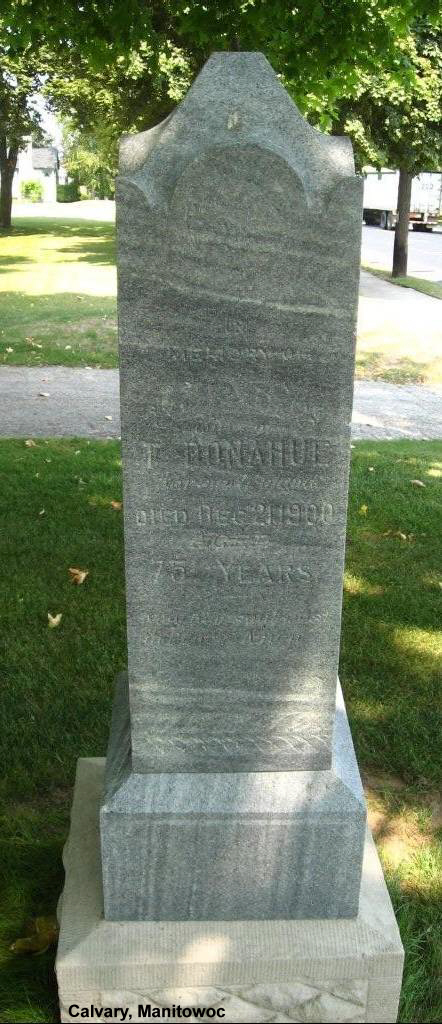
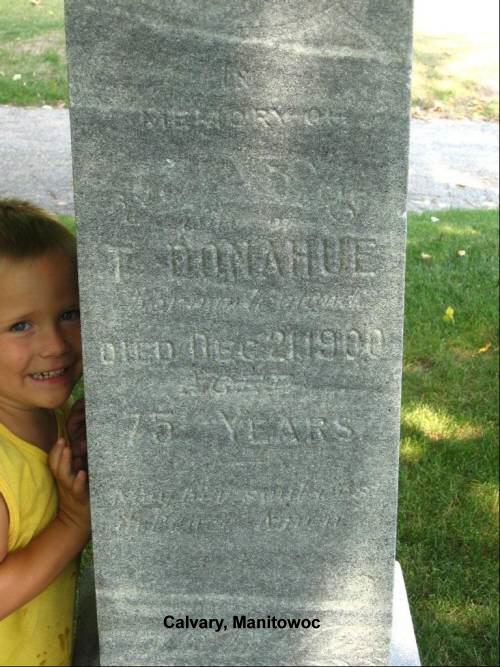
This record deals with what family information has been found on the internet and primarily from one valuable online source for Manitowoc Genealogy, http://www.2manitowoc.com/. This web-page has provided a wealth of information and is probably the best I have encountered regarding our family history. As of now what is reflected here deals with the records regarding the cemetery of St. Isidore’s Catholic Church in Meeme where our grandmother Mary Ellen Donahue was born and raised. Our Great-Grandparents, Thomas and Mary Donahue are not buried in this cemetery however. After selling the Donahue farm near the end of the 19th century they purchased a small home in Manitowoc where they lived out the rest of their lives. They were buried in the Calvary Catholic cemetery in the town of Manitowoc. The web source mentioned here has pictures of the Donahue grave marker posted on their web-page, one of very few pictures they post, and the following links will take you to those pictures. A small boy is captured in one photo and he remains unidentified.

http://www.2manitowoc.com/01/43donahuemary.jpg
http://www.2manitowoc.com/01/43donahuemary2.jpg

When one attempts to gather information on any family of the 1800’s the most accessible and credible source is always the records of the local churches that the ancestors attended. That has proved to be the case for both of our Irish ancestral families, the McGinnis’s of Chatham, New Brunswick and the Donahue’s of Manitowoc County, Wisconsin. In New Brunswick it is St. Michael’s of Chatham and in Wisconsin it is St. Isidore’s of Meeme or Osman. Meeme is where the Donahue home was located for most records and Osman, but a few miles away, is where the church was located. Only the cemetery remains an active part of a new parish near by. The old church and school have apparently been torn down or sold off. The Meeme-Osman area of Manitowoc County is about 15 miles to the southwest of the city of Manitowoc and but 3 miles to the west of Interstate 43 that runs north from Milwaukee to Green Bay, Wisconsin, following the Lake Michigan shore line.


The following short description and photo regarding St. Isidore’s is from the wonderful source mentioned above: http://www.2manitowoc.com/


ST. ISIDORE CATHOLIC CEMETERY

Meeme Township, Manitowoc Co., Wisconsin
Location: Located on the east side of Highway 42 in Osman, directly in back of the church and school. The cemetery is well kept but does have large areas where there are no longer any markers. Copied Saturday and Sunday, August 20 and 21, 1977 by Marcie Baer, a member of the MCOCS. Earliest remaining stone is 1856.


By accessing a list on the Manitowoc web-site that transcribes the names and dates of all the headstones for the St. Isidore’s parish cemetery the Donahue’s of Manitowoc County are represented. Several graves of various ancestral family members are easily identified and can be traced on our family tree. A few other Donahue’s cannot be connected to our line but I strongly suspect that someday a connection might be proven.

Below is the list which appears to be the recorded Grave Transcriptions integrated somehow with actual parish records. The combination of data has led to some discrepancies between the two sources and they are not sorted out here. Actual relationships to our Great-Grandfather Thomas Donahue have been added after collaboration with other Donahue family history researchers. This is a combined effort of me, Molly McGinnis Wright of Dundee, Oregon, Sharon Donahue Moniowczak of Bark River, Michigan and Floyd Billings Jr., of Provo, Utah.

As is common with many ancestral surnames, the Donahue name also emerges from past records with several different spellings. Some variants are “Donaghue with or without the “O” in front, Donahoe or even Donohoe. O’Donaghue appears to be the most common spelling found in many 19th century records originating in Ireland, but not necessarily the original version. Many times the spelling is a clerical error and at other times different families adapted their own choice of spelling after they immigrated. What survives in the records of St. Isidore’s may be attributed to both reasons. We have no definite reasoning to apply to what the records reflect today.

Sharon Donahue Moniowczak and her brother, Richard Donahue, have compiled more extensive Church, Cemetery and even County records that I will attempt to scan and post at a future date. Their effort really needs to be properly recognized and presented as a stand alone posting. They put forth a considerable effort to gather all they did and it is greatly appreciated by the rest of us.

As always, I can only suggest that if you want to make any sense out of all of this that you download a Donahue family tree that I have uploaded and stored on Google Documents. That tree can be found at the following link but you will need to log into Google to view it-
http://docs.google.com/fileview?id=F.2d2eb78f-c53a-4948-b2eb-22fda413d199&hl=en&pli=1

One abbreviation might need explaining, i.e. “OSSW” has the meaning “On the same stone with”.


Michael Donahue-
Grave Transcription-
Michael, Son of, T.& M.A. Donahoe, Born, Sept. 20, 1885, Died Febr. 16, 1886,
Budded on earth, in bloom in heaven., ossw: 1885-1886

Relationship to Thomas Donahue Sr.:
Grandson of Thomas Donahue Sr. and Mary McKeough Donahue, son of Thomas Donahue Jr.

For my generation, this would be a son of our Grand-Uncle, Thomas Donahue Jr. Relationship tables do not actually assign a relationship of the son to my current generation. The tables stop assigning at the level of the father of this Michael Donahue.

Thomas Donahue-
Grave Transcription-
Thomas Donahoe, Born June 9, 1857, Died, March 14, 1887 (War vet flag holder)
Footstone: T.D.
1857-1887

The Church Record for the burial states:
Thomas Donahue, no stone, d. 14 Mar. 1887, age 29 yrs., husband of Maria Anna Donahue (from records of St. Isidore Cath. ch. bk.1 p.201)

Relationship to Thomas Donahue Sr.:
Son of Thomas and Mary McKeough Donahue and an older brother of our Grandmother, Mary Ellen.
This is the father of Michael Donahue as explained in the first Grave Transcription above and a Granduncle to today’s generation.


Patrick Donahue-
Grave Transcription-
Patrick Donahue, ossw: Wife, Honorah

The Church Record for the burial states:
Patrick Donahue, d. 9 Jan. 1917, age 88 yrs, (from records of St. Isidore Cath. ch. bk.1 p.220)

Relationship to Thomas Donahue Sr.:
Brother. Brother Patrick emigrated from Ireland in the mid-1850’s after his brother Thomas had begun farming. Most likely Thomas promoted if not financed his younger brother to help him immigrate and begin his life of farming nearby.

Hanorah Donahue-
Grave Transcription-
Hanorah, wife of P. Donahue, Died June 20, 1896, Aged 63 years, a native of Roscommon Ire., ossw: Husband, Patrick1833-1896


The Church Record for the burial states:
Hanora Donahue, d. 22 June 1896 (from records of St. Isidore Cath. ch. bk.1 p.206)

Relationship to Thomas Donahue Sr.:
Sister-in-law, wife of Brother Patrick.

Hanorah’s maiden name was Luby. She married Patrick Donahue about 1858 in Manitowoc County. No trace of her family line has been found to date. She also was an immigrant from Roscommon in Ireland, an area just to the north of Galway where the Donahue’s originated.

John Donahue-
Grave Transcription-
John, Son of, Patrick & Honorah, Donahue, Died, June 23, 1897, Age 34 years.
1862 or 1863-1897

The Church Record for the burial states:
John Donahue, d. 25 June 1897, age 30 yrs (from records of St. Isidore Cath. ch. bk.1 p.207)

Relationship to Thomas Donahue Sr.:
Nephew, son of Brother Patrick and Hanorah.

To the current generation this is a “first cousin, twice removed”. Removed in essence only indicates the individual was of another generation. Our cousin Tommie of Florence is a first cousin once removed. I constantly have to refer to the following definition each time I come across the relationship in our family data.


Patrick Donahue-

The Church Record for the burial of Patrick Donahue provides the following:
Patrick Donahue, d. 7 Dec. 1899, age 22 yrs, par. John Donahue and Margaret Fitzgerald (from records of St. Isidore Cath. ch. bk.1 p.209)
1877-1899

The following notation was inserted into the internet list. It was taken from a local German language newspaper. The Irish and the German farmers of the region lived side by side and the families intermarried as in the case of Margaret Donahue, our Grandmother’s sister that married an Arnold Siehrs. They preserved their separate cultures but in essence they were all proud members of the local community.

From Der Nord Westen, 14 Dec. 1899:

Patrick Donahue of Meeme, who was working in a lumber camp near Menominee, Michigan on Thurs. last week, was hit by a falling tree and killed. His body was brought to Meeme for burial. He was 22-1/2 yrs. old.

Relationship to Thomas Donahue Sr.:
Grandson, son of John Donahue-
To the current generation, he also would be a first cousin, once removed.

Removed-

When the word "removed" is used to describe a relationship, it indicates that the two people are from different generations. You and your first cousins are in the same generation (two generations younger than your grandparents), so the word "removed" is not used to describe your relationship.

The term "once removed" mean that there is a difference of one generation. For example, your mother's first cousin is your first cousin, once removed. This is because your mother's first cousin is one generation younger than your grandparents and you are two generations younger than your grandparents. This one-generation difference equals "once removed."

Twice removed means that there is a two-generation difference. You are two generations younger than a first cousin of your grandmother, so you and your grandmother's first cousin are first cousins, twice removed.

John Donahue-

The Church Record for the burial of John Donahue states:
John Donahue, no stone, d. 1 Oct. 1912, age 62 (from records of St. Isidore Cath. ch. bk.1 p.217)
1850-1912

Relationship to Thomas Donahue Sr.:
Son of Thomas and Mary McKeough Donahue.
A Granduncle to today’s generation.

One of the few if not the only child of Thomas and Mary that lived his life out in the Meeme or Osman areas.

Ida Donahue-
The Church Record for the burial of Ida states:
Ida Donahue, no stone, d. 18 July 1911, age 20 yrs, par. John Donahue and Margaret Fitzgerald, from records of St. Isidore Cath. ch. bk.1 p.216)
1881-1911

Relationship to Thomas Donahue Sr.:
Granddaughter, daughter of John Donahue and Margaret Fitzgerald

William Donahue-
The Church Record for the burial of William Donahue states:
William Donahue, no stone, d. 30 Nov. 1906, age 19 yrs (from records of St. Isidore Cath. ch. bk.1 p.213)
1887-1906

Relationship to Thomas Donahue Sr.:
Grandson, son of John Donahue


The Donohue’s within the record that follow appear not to be related. Molly McGinnis has a very curious mind and is very good at bringing up possibilities and some of her notations are included here for future reference.

Donahue-
Grave Transcription-
Mary Donohue, daughter of, Patrick & Mary HAYES, and wife of Michael Donohue, Born March 20, 1818, Died Oct. 7, 1876, ossw: 1818-1876

Relationship to Thomas Donahue Sr.:
Unknown relationship. Most likely not related.

Molly’s comment:

Another puzzle. In 1860 in Meeme, there’s a Charles & Margaret in their household as: John Hayes, Michael Donahue (age 50 born Ire), Jeremiah Donahue (age 15 born Ire), and Mary Donahue (age 8 born Pennsylvania). It’s interesting that a John Hayes is listed as he could be a brother-in-law to this Michael Donahue if he’s the Michael married to Mary. However, the only Mary listed is an 8 year old. Notice again, that young Mary was born in Pennsylvania as the earliest Jeremiah Donahue children were. This is looked like a good possibility as John Hayes is listed and supposedly Mary Donohue was the daughter of Patrick & Mary Hayes—they may have been siblings. But where’s Mary born 1818? Could they have not gotten married until after 1860? Perhaps this Michael had been a widower?

Another possibility, is in 1870 in Plymouth, Sheboygan Co. There’s a Michael born 1807 Ire, Mary born 1820 Ire, along with a Mary 16, Patrick 14 and Dennis 12. Since the Jeremiah group was in Sheboygan Co, there may be a connection there, too. Hope Floyd has some input for this one.

My comment:
When Brother Patrick arrived from Ireland, he undoubtedly traveled with another sibling, Mary Donahue. Mary appears in the records at about the same time that Patrick does suggesting the older brother Thomas may have provided the means for both of his siblings to immigrate. Perhaps there were other family members in Ireland that did not come to the U.S. leaving the possibility that we may have relatives in Ireland even today. That remains to be proven.


Mary Donahue, again, a sister of our Great-Grandfather, married one Arnold Siehrs as mentioned earlier. The next five descriptions are of Mary’s family. The children of Mary and Arnold of course would be distant cousins to our current generation.

Arnold Siehrs-
Grave Transcription-
Arnold Siehrs, Dec. 25, 1866, Apr.8, 1939
1866-1939

Relationship to Thomas Donahue Sr.:
Nephew, son of Mary Donahue Siehrs and husband Arnold

Mary Siehrs-
Grave Transcription-
Mary Siehrs, Dec. 25, 1819, Apr. 30, 1915, next to Large Siehrs monument,
1819-1915

Relationship to Thomas Donahue Sr.:
Sister, Mary Donahue Siehrs.
Also next to Large Siehrs monument


Arnold Siehrs-

Grave Transcription-
Arnold Siehrs, Dec. 13, 1817, Jan. 3, 1896, next to:
1817-1896

The Church Record for the burial states:
Arnold Siehrs, d. 6 Jan. 1896, age 73 yrs. (from records of St. Isidore Cath. ch. bk.1 p.206)

Relationship to Thomas Donahue Sr.:
Brother-In-Law , Husband of sister Mary Donahue Siehrs
John Siehrs-
Grave Transcription-
John, Sept. 26, 1863, Oct. 13, 1934,ossw:
1863-1934

John Siehrs-

Grave Transcription-
John, Sept. 26, 1863, Oct. 13, 1934,ossw:

1863-1934

Relationship to Thomas Donahue Sr.:
Nephew, son of Mary Donahue Siehrs and husband Arnold.

Catherine Siehrs-
Grave Transcription-
Catherine, July 31, 1873, May 12, 1941
1873-1941

Relationship to Thomas Donahue Sr.:
Wife of Nephew, John Siehrs


Donahue’s- Related or not ?

Another Donahue Family is at rest in St. Isidore's and collaboration with others results in no connection to our Donahue’s. Some comments that passed between us while attempting to sort all this out are included here.

Family Marker Description-
Large stone-family name only. Separate stones read:

Katherine, 1856-1928, next to:
Nellie, Apr. 9, 1865, Apr. 23, 1913, next to:
Katharine, Sept. 15, 1819, Oct. 6, 1897, next to:
Jeremiah, Jan. 6, 1822, Dec. 20, 1909

Relationship of this family to Thomas Donahue Sr.:
Unknown, if any

Molly’s comment:
This is Jeremiah & Catherine Donahue with two of their daughters. Again, how are they connected to Thomas?

Floyd’s input:

This refers to a family that lived mostly in Sheboygan County. Much information about them is available in the Sheboygan county website. The mother's maiden name was Hayes and that is presumably what made for a connection to St. Isidore.

Church Records reveal the following detail of the family:
Jeremia Donahue, d. 23 Dec. 1909 (was buried at St. Michaels, Mitchell, Wis. moved to St. Isidore Cemetery, 3 Oct. 1911 (from records of St. Isidore Cath. ch. bk.1 p.216)
1822-1909

Molly’s comment:

Jeremiah Donahue was the husband of Catherine Donahue listed in #11. I’m hoping that Floyd has the connection to Thomas, if there is one to be had. Jeremiah & Catherine are in Plymouth, Sheboygan Co. in 1860; Greenbush, Sheboygan Co. in 1870; Mitchell, Sheboygan Co. 1880, 1895; & Jeremiah is living with son, Bart (Bartholomew) in 1900 also in Mitchell. Jeremiah immigrated in 1846 and was born in Ireland in Jan 1822 according to the 1900 census. Remember Floyd sent us a copy of a photo of one of his family with “relatives in Sheboygan”. Could these relatives possibly be connected to the Jeremiah Donahue family? Jeremiah & Catherine had a whole slew of kids: Johanna, Timothy, Eliza,

Catherine Donahue, d. 8 Oct. 1897, age 78 yrs (from records of St. Isidore Cath. ch. bk.1 p.207)
1819-1897

Helena (Nellie) Donahue, d. 23 Apr. 1913, age 47 yrs, from records of St. Isidore Cath. ch. bk.1 p.218)
1866-1913

Another different family:

Grave Transcription-

Mikey, son of Cors & Mary Donohoe, Born Sept. 25, 1863, Died Aug.17, 1873
1863-1873
:

Relationship to Thomas Donahue Sr.
Unknown, if any

Floyd’s input:

Mikey is presumably a son of Cornelius & Mary Donahue who lived in Manitowoc 3rd ward for a short time around 1880. Cornelius was a railroad engineer.