Showing posts with label Chatham. Show all posts
Showing posts with label Chatham. Show all posts
Monday, February 4, 2013
Margaret McCarron McGinnis and the Year 1861
It had to have been a difficult year for our great-grandmother. Her husband John died in February of the year leaving her with a family of six to support and none of age enough to have working skills of their own. The oldest, her stepson Patrick, was sixteen and probably capable of finding some sort of minor employment in order to bring in a meager amount of support to help with the sustenance of the family.
I suspect it was a time of charitable giving and receiving coming from close family and friends in the community and the major sources of help certainly might have centered around the local Parish Church, St. Michael’s. But what might have been the family situation following the death of the family breadwinner can only be speculated on. What follows are some possibilities of what might have developed for the family as discussed and speculated on by myself and Molly McGinnis. It is only conjecture for the census of 1861 only provides questions and no real substantial answers regarding Margaret McGinnis and her children.
John McGinnis Sr. was a cobbler by trade and at the time his trade was defined as a Cordwainer according to the only census entry found for him in 1851 in Chatham. Perhaps he was working out of his home or employed elsewhere in the village of Chatham. By 1861 it very well may have been considered more than a village, more likely a small town, a small and prosperous town I suspect.
The era of wooden ships was alive and thriving and the small town had an ample shipbuilding industry long established in the community. The Cunard family being the principle owner of the apparently largest shipyard along the Miramichi River where so many of the wage earners of the local Irish community earned their salaries. Other members of the Cunard family went on to form a successful shipping company originating in St. John’s, New Brunswick that still exists today. The Cunard company was the major shareholder in the White Star Line, the company that eventually financed and commissioned the building of the the fateful ship Titanic.
Ten years before his death, in 1851, John Sr. practiced a trade of a cobbler or cordwainer, of which there were 20 in the overall population of 1700. Obviously he passed his skills on to none of his sons for the evidence is that most followed the obvious trade of ship carpentry, a much needed skill in the shipyards. Wood from the abundant forests along the upper Miramichi and the availability of such downstream in Chatham was the driving force behind the establishment of the shipbuilding industry that the small town became famous for. The era of wooden ships by 1871 was being replaced by modern steel ships being built first in Europe during the emergence of the era of steel ocean vessels. This transition can be directly attributed to the McGinnis family’s eventual migration out of Canada and to the United States. The industry eventually died in their small town and employment prospects were much greater in the land to the south, the U.S,
Margaret and her brood continued to strive on, obviously, following the death of the family head but apparently it was not an easy time for her. The Canadian Census was taken later that year and Margaret and her family do not appear, at least as a family unit. The entire family may have been missed in the count that year.
Searching through the census of 1861 there are possible entries for some of the family members suggesting that maybe some of the children were living with family and friends but nothing to date can really be pieced together in order to create a valid picture of just what the family was experiencing. The entries that are found cannot really be established to be of Margaret’s family. This leads me to suspect that Margaret may have been experiencing difficult times finding ways to support her children, a rather likely experience for any new widow with a large family.
Margaret’s oldest charge, her stepson Patrick, just might have been the redeemer of the family. His personal enterprise as reflected in his later success in life suggests that he very well could have been assertive enough to step in and slowly helped the family financially, even at such a young age. If there were employment possibilities for one so young then younger brother James surely soon began to add help for the family sustenance as well. With her family coming of age in that decade it is easy to assume they all pulled together to keep the family intact. But the few years immediately following the death of John Sr. had to have included some trying hardships for all to experience.
So the story of what transpired for the remaining McGinnis family for the next ten years, until the next census of 1871, is only something to be wondered about. The 1871 census reveals that the family is together along with Margaret’s father and a sister. The appearance of these latter two individuals suggests that times may have improved over that decade as the two new McCarron's in the household are certainly new immigrants for they do not appear in any earlier Canadian census in any province, at least not within any of my data searches. Somehow, collectively I surmise, enough funds were put together to enable the two to book passage to Canada to join Margaret. This alone establishes that some level of prosperity had taken place. The possibility that the father and sister provided their own funding to emigrate out of Ireland is rather unlikely based strictly on the economy of Ireland during the period. Possible I suppose, but to me rather unlikely.
So 1871 arrives and the economy of Chatham, New Brunswick slowly began to decline as the era of wooden shipbuilding began to die out. The rest of the story plays out in the U.S. and it amazes me how they all ended up in Washington State still a family unit of extended family for many years to come.


Wednesday, January 30, 2013
St. Michael’s Cemetery, Chatham, NB…..Another Grave Yet to be Found……Hopefully Never Forgotten
Where lies James McCarron………… ?

St. Michaels Basilica and Cemetery
There is no new uncovering of facts here but what this does accomplish is raise questions yet to be answered. It tells a basic story without all , organizing and describing and posting these small facets of our ancestors past comings and goings is that almost every discovered fact very often leads to more questions. Thus this serves as a place to bring up those questions and hopefully as time goes by some of the unknowns will be resolved. At least this becomes a place for me to be reminded of what needs further looking into in order to uncover some long lost family information.To explain, James McCarron is the father of Margaret McCarron, later married to John McGinnis Sr. This would make James McCarron the Great-Great Grandfather to my generation, the direct descendants of Mary Agnes McGinnis.
The man holds the distinction of the oldest identified ancestor in the McGinnis/McCarron line and the oldest ancestor born in Ireland and buried on North American soil. The actual proof of his existence can be found in but two pieces of documentation found in Chatham, New Brunswick records.
The first piece of evidence regarding his identity is to be found is his inclusion in the 1871 Canadian Census living in the household of what most certainly is his daughter, Margaret McCarron McGinnis. This was some ten years following the death of Margaret’s husband John McGinnis.
Margaret McGinnis Transcription 1871 Canadian Census
Chatham division 3, pages 1 & 2, Margaret McGinnis, 50, Patrick, 23, James, 22, John, 20, Arthur, 18, Sarah, 16, Hugh, 13. Also in same household, McCarron, James, 80, Mary, 40. Patrick and James are listed as carpenters, John as a school teacher, Arthur as a laborer. Sarah also has an occupation listed that is unreadable.


Margaret McCarron McGinnis
Circa 1890, She left her Father in the Graveyard of St. Michaels
Note: The dark material outlining her head appears to be the back of a chair or something she is sitting on at the time
The second piece of evidence is his record of death and burial in the archives of St. Michael’s parish church in Chatham. The death date is followed by burial two days later. His burial in the church cemetery is undisputable however a search of an hour or two in the rain during my last visit to Chatham, in the summer of 2007, even with the help of two friends, we could not locate his grave. Is it lost to time, I certainly hope not for it needs to discovered and honored in some respectful way.As in many old cemeteries the earliest graves tend to lack maintenance over the years as cemetery funding diminishes and family, relatives and descendants die off or leave the area. This eventuality very well may be the case for the grave of James McCarron leaving the possibility that his grave marker may have been destroyed by the weather alone. The museum historical records merely record the death and burial information and the actual grave location was not indicated. The museum directed me to a caretakers office to see if they had the precise location but that facility was not open the day I was there. The grave location might be found in those separate records maintained by the parish Sexton or others in the church office with access to the actual records.

James McCarron Death and Burial Record
(lower left entry)
Found and photographed at the St. Michael’s Museum and
Historical Center


The 1871 census really adds more questions than facts. Ten years after her husbands death Margaret has then living in her household, other than her children, what appears to be her father and most likely a sister. What are the circumstances that allowed two family members, most likely rather newly arrived from Ireland, to join Margaret and her brood? Who or what provided the funding for this to occur? Another question for another time.
This all leads to another rather basic unanswered question regarding the family survival after the death of John Sr.. Was Margaret and her children left in near poverty or was it actually the opposite of conditions? However, this needs some additional thought for a posting on the subject at a later date. Of course the primary question in this posting is where in St. Michael’s cemetery does James McCarron lie? Someday I hope to find the grave.
Friday, November 30, 2012
Examining Possible Relationships From Church Records, Nelson and Chatham, Northumberland County, New Brunswick Canada / Marriages of Catherine and Mary McGinnis, Our Great-Grandaunts / Also the Ferguson Connection
It has proved impossible to date to find any data or method to really define where any of our Irish ancestors resided in the home country. Someday that may change but as of now the only records of any kind for either the Donahue’s or the McGinnis families can only be found in North American records beginning around the mid 19th century. Finding even these records has proven out to be a significant find for me personally. This is an attempt to present some sort of a lasting record regarding what we know so far. Again this is an attempt to piece together a few facts and provide some sort of an explanation for others someday to expand on as other records are found about the family. I do not consider this as proof of anything, only my assessment of the events.
With the McGinnis family, the earliest surviving documents to be found during my searches are to be found in the Catholic parish records of Eastern Canada. These records are found on microfilm and published by the Drouin Genealogical Institute of Quebec. This storehouse of information is priceless and it’s origin is as described from a posting here in June of 2009:
“The Drouin Genealogical Institute of Quebec took on the task of microfilming all the church records of the various Catholic parishes administered out of Quebec City which is a considerable amount of records. The area involved in the task essentially covered every parish in the provinces of Quebec, Prince Edward Island, New Brunswick and Nova Scotia, all under the auspices of the presiding Archbishop or Cardinal residing in Quebec City or Montreal. The effort begun in the 1940's was primarily meant to record French genealogy records but as is evident the task encompassed all parishes, French or English speaking. Since the Maritime Provinces, unlike Quebec of course, are primarily English speaking with many sizeable pockets of French culture it was determined that all records would be filmed in order to capture the data of all the French families”.
Searching through these records the possible existence of other early McGinnis family members to Canada began to surface, namely the names of two likely sisters of our McGinnis Patriarch, John McGinnis Sr. John immigrated to Canada in 1836 and died in Chatham, New Brunswick in 1860 leaving behind his second wife Margaret McCarron and six children, one of which was James McGinnis Sr., our grandfather. The two possible sisters can only be proven through making associations recorded in the parish records which is not a foolproof method but it the only process available due to the lack of civil records.
The two possible sisters are Mary and Catherine McGinnis. Those two names combined as Mary Catherine were passed on to two succeeding generations of the family of Hugh and Catherine McGinnis. Hugh of course was a brother of our grandfather James, both of the surviving six children of John Sr. This is not a definite proof of the existence of the two possible sisters of John Sr. since these are both such common names in the Irish tradition of naming children. But it is something to be considered when attempting to piece all this together.
The most direct proof that might apply then are in the parish records of two churches, St. Patrick’s in the small community of Nelson and St. Michael’s in Chatham, the two small towns being but ten miles apart. St. Patrick’s was established about 1811 and St. Michael’s in 1839. Keep in mind an extremely confusing issue comes to play here in that a McInnis and a McGinnis came together in marriage making the records somewhat mind boggling to read through at times. Keeping the names straight while attempting to absorb the events and dates has proved out to be very challenging at times.
The following events have been found in the microfilm records but they are not all the entries regarding the family available. I only include those events that I feel tend to validate the existence of the two sisters of John McGinnis Sr. The events and the witnesses are the key to this puzzle. The names of Mary and a sister Catherine intertwine in important family events over a period of many years. It may only be circumstantial on the surface but personally I do believe it is highly probable that the two sisters did exist.
- According to the 1850 census of Chatham an entry states that John McGinnis Sr. entered Canada in 1836. This is my beginning point for our McGinnis family.
- An entry in the parish record of November 18, 1839 in St. Patrick's parish in nearby Nelson records the marriage of one Andrew McInnis and Catherine McGinnis. At this point we might only assume this is a sister of John Sr. for one John McGinnis is a witness. It is still not established that this is the same John McGinnis that entered Canada in 1836 nor that John and Catherine in the record are brother and sister. This also begins the task of attempting to keep the two surnames, McInnis (sometimes spelled McInnes) and McGinnis straight in the mind to keep the spellings from confusing the issue. McInnis and it’s variants are of Scotch descent and of course McGinnis is of Irish origin.
- The next date of interest in December 27, 1840 when at St. Michael’s parish in Chatham, Andrew McInnis and Catherine McGinnis baptized their first child John McInnis. Witnesses were John McGinnis and Mary McGinnis. We still cannot say for sure that this is the same John McGinnis that entered Canada in 1836. It is reasonable to assume though that the parents of the child are the same that married about a year earlier in Nelson. What is worth considering here is that one John McGinnis was a witness at both events suggesting that it is the same person in both instances. The record spells the parents name as McGinnis and I suggest that the priest was in a hurry and did not record the surname of McInnis correctly. These records were sometimes put together days if not weeks after the actual events providing room for error as the priest might sometimes attempt to bring his records up to date from memory only. Spelling of surnames was really rather haphazard at times regardless of when the record was entered which is easy to see when looking through many microfilm pages.
- On January 30, 1845 a marriage record is entered in St. Michael’s parish in Chatham between John Ferguson and Mary McGinnis. This marriage is what establishes the relationship of Mary Agnes McGinnis and Mary Mills as second cousins. It was well known in our family that the two, our mother Mary Agnes and Mary Mills, were cousins and in order for this to be a fact this marriage establishes that John Ferguson married a McGinnis of our line, a sister of John McGinnis Sr. in all likelihood. It is well known that John Ferguson was the grandfather of Mary Mills and he was married to Mary McGinnis and for the cousin relationship to be established Mary McGinnis, the grandmother of Mary Mills, had to be of our McGinnis line. This works out to establish that an unknown McGinnis in Ireland, the father of John McGinnis Sr. and his sister Mary McGinnis Ferguson, was a great-grandfather to both of these cousins. Note: this marriage was entered in the records as both January 30 and September 30, 1845. I have accepted the earlier date for now due to date of birth of the first child of the marriage, Robert, in late December 1845.
- Time goes by and the next date of interest in the church records is December 21, 1845 when Robert Ferguson the first child of John Ferguson and wife Mary McGinnis was baptized. This child later becomes the uncle of Mary Mills and the man that established his farm in Florence next to James McGinnis. The two were first cousins based on the unknown McGinnis patriarch in Ireland. Both men settling next to one another to live out their lives adds to the credibility of the relationship of the two families. Robert never did marry but his sister Catherine married Luke Mills and were the parents of Mary and Charlie Mills.
- On September 15, 1847, our grandfather James McGinnis, first child of John McGinnis Sr.and Margaret McCarron, was baptized. The godparents were one John McCarron and Mary Ferguson. If the tradition of naming relatives as godparents holds true then assumedly Mary (McGinnis) Ferguson is a relative. John McCarron is a mystery but if tradition is followed here then he might be a brother or cousin of the mother, Margaret McCarron. John McCarron disappears from all records after this event.
- John McGinnis Jr., the second child of John McGinnis Sr. and Margaret McCarron, was baptized on August 26, 1849. The godparents were Andrew and Catherine McInnes. Again, if tradition is followed then the godparents were relatives. This adds substance to the relationship of Catherine as a probable sister of John McGinnis Sr.
- On March 25, 1850 the fifth and last child of Andrew McInnis and wife Catherine McGinnis was baptized. The godparents were John Ferguson and Margaret McCarron. This brings family in as godparents as John Ferguson is married to Mary McGinnis and Margaret McCarron was the wife of John McGinnis Sr.
One issue remains to be examined and it may be very important and that is to examine the entry dates to Canada of the two sisters, Mary and Catherine, as well as their year of birth. It very well may work out that the sisters immigrated before their brother John McGinnis and these facts might cast a different light on what I have presented here.
To summarize…………….
Credibility of Catherine McGinnis are found in items 2, 3, 7 & 8
Credibility of Mary McGinnis are found in items 3, 4, 5 & 6
I apologize if this really belabors the issue and only tends to present a confusing explanation of my take on all this. To me it is all rather clear and that I suppose is because I have pored over these records so many times and as a result much of it is committed to memory. Not everyone will see it as I do but do give it time. It very well may eventually make sense, at least that is my hope.
Tuesday, June 9, 2009
McGinnis Family Records, St. Michael's Parish, Chatham, New Brunswick
 James McGinnis Sr.
 About age 35
Copied from a photo taken in Chicago about the time
of the marriage of James and Mary Ellen Donahue in 1883
The following inserted pages are microfilm photo copies of the actual records of St. Michael's Parish in Chatham, New Brunswick or some adjacent parish. Some are extremely difficult to read due to the penmanship of various priests as they recorded the dates they gave the Sacraments of Baptism and Marriage to their many parishoners.
The Drouin Genealogical Institute of Quebec took on the task of microfilming all the church records of the various Catholic parishes administered out of Quebec City which is a considerable amount of records. The area involved in the task essentially covered every parish in the provinces of Quebec, Prince Edward Island, New Brunswick and Nova Scotia, all under the auspices of the presiding Archbishop or Cardinal residing in Quebec City or Montreal. The effort begun in the 1940's was primarily meant to record French genealogy records but as is evident the task encompassed all parishes, French or English speaking. Since the Maritime Provinces, unlike Quebec of course, are primarily English speaking with many sizeable pockets of French culture it was determined that all records would be filmed in order to capture the data of all the French families.
Thus many if not most of the records of our Irish Canadian ancestors came to be preserved forever and through the magic of the computer age these images are all indexed and available for easy access over the Internet. To me personally this source has been a treasure and what you view here is primarily data of our primary interests. Many other pages involving the families that various ancestors married into have also been downloaded and saved for future reference. Tracing Godparents has been a useful tool in establishing family connections and for that reason alone all these records have been a valuable source to help piece together all that is known today.
You will notice that some entries are purposely obscured or covered over for some reason. Most likely this was done for reasons of privacy but just how that was established is yet to be discovered. It occurs often through out the Drouin collection. Another common practice during the filming was to insert a loose page of information into the record which resulted in some entries being covered over. I later discovered that these pages were filmed twice so that all data was eventually filmed.
To enlarge the view simply double-click on the image.

Baptism Record of James McGinnis
September 15, 1847
Chatham, Northumberland County, New Brunswick
The record for James is on the right side of the image, third entry from the top

Reverend John Sweeney
1821-1901
1821-1901
Baptising Priest of James McGinnis
Father Sweeney was the second priest to serve the
parishinors of St. Michael's after it's establishment in 1839,
three years after our Great Grandfather John McGinnis
arrived from Ireland

Baptism Record for John McGinnis Jr.
August 26, 1849
Third child of John McGinnis,
Second child of Margaret McCarron
The record for John is on the left of the image,
fourth entry from the top
The record for John is on the left of the image,
fourth entry from the top

Baptism Record for Patrick McGinnis
August 3, 1845
First born child of John McGinnis Sr. Mother is Mary Buchanan. She apparently died shortly after the birth for no further record can be found for her. This is a stepson of Margaret McCarron that obviously raised Patrick as her own son.
The record for Patrick can be found scrawled at the bottom right of the image.

Marriage of Arthur McGinnis Sr.
October 30, 1878
Younger brother of James McGinnis Sr.
Arthur married Mary Margaret Buckley.
Both are buried side by side in Calvary Cemetery in Seattle.
The record entry is at the top left.

Marriage of Sarah McGinnis and
Patrick Fitzpatrick
September 17, 1884
Only sister of James McGinnis Sr. and both are also buried side by side in Calvary Cemetery in Seattle.
The record entry is at the bottom right.
Wednesday, February 25, 2009
Chatham, New Brunswick- Now Miramichi- Combined With, Nelson and Newcastle Across the River-

 The Irish Heritage is Very Evident
 Proudly Self-Proclaimed
"The Irish Capital of Canada"
 A Downtown View
 Old But Well Cared For Homes

 The View From St. Michael's Church

 Downtown, Water StreetStill a very narrow passage
 Along the River
 A Downtown View
 Old But Well Cared For Homes
Some of these homes very well were in place
well over 100 years ago

 The View From St. Michael's Church
 Downtown, Water StreetStill a very narrow passage
  Along the River
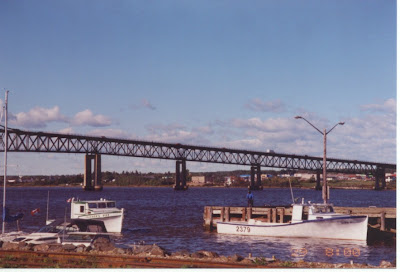
The bridge can be seen for miles
 Compared To The Rest of New Brunswick
 Compared To The Rest of New Brunswick
Very Few Lobster Boats
 St. Michaels

 Where Our Ancestors are at Rest
 St. Michaels Dominates the View From Across the River
 St. Michaels
Erected in the early 1900's as the Bishops Church who has
since relocated to Bathurst

 Where Our Ancestors are at Rest
 St. Michaels Dominates the View From Across the River
Tuesday, February 24, 2009
The Carpenters From Chatham

Where they were born, raised and learned their skills-

I have not found the family in the 1861 census records but the 1871 Chatham census reflects the family all intact, with Patrick, 23 and James 22, both listed with the occupation of carpenter. Son John Jr., age 20, was already a schoolteacher, and son Arthur, 18, is listed as a laborer. Sarah and Hugh were still of school age.
All indications are that the carpentry skills brought to Florence in the 1890’s were a major factor in the eventual success of the farms of our ancestors. They came from New Brunswick and improved their skills over a ten or fifteen year period along the way to Washington State where some of them decided to pack it all in and become dairy farmers.
To create a working farm from scratch required facilities. Homes, barns and sheds had to be constructed and that they did either individually or as a cooperative endeavor, most likely the latter with all pitching in to help one another. Of course carpentry is a far cry from animal husbandry but again by combining all their skills, the women included, they eventually brought it all to fruition. It is certain the Donahue sisters contributed the knowledge they learned from their upbringing in Wisconsin, the small things that a young man from a small city in Canada was never aware of. All the small group of Irish pooled their resources and knowledge to help bring about the community success. They had every right to be very proud, these McGinnis brothers, Cousin Robert Ferguson and early Chatham friend, James Hall. A very tight knit group. Four farms, side by side all with the head of household born in Chatham, New Brunswick, three with wives of the same Wisconsin Donahue family.
It is not clear to me at the moment but the carpenters skills may have divided into two basic categories. One group would be trained as shipwrights or shipbuilders, those that constructed the hulls and placed the bulwarks and frames of the basic ship. Another group appears to have been more focused on what one might define as finish carpenters, general carpenters or even cabinet makers, those that would be used in various other endeavors of carpentry as well as the final stages of ship construction. Perhaps they built the ships cabins and finished off the holds of the ships, or were even employed in general construction of onshore shipyard buildings in the yards. They may have even been defined as facility or maintenance carpenters.

 Chatham, New Brunswick In The 1890’s
Probably Less Than Ten Years After The McGinnis Family Left The Small TownThe Main Street Is still a narrow passage Paralleling The Miramichi River and is very mindful of this scene even today.
Thus the probable reason so many of the men from Chatham were listed in their census entries of the years after their immigration to the States with the occupation of Carpenter, Shipbuilder or Shipwright. To me it is obvious that the skills were all acquired within the shipyards of New Brunswick, Canada. St. Johns, Bathurst and Chatham competed but I am of the understanding that the majority of the activity of building wooden ships occurred in Chatham with St. Johns and other scattered communities providing the rest. Regardless it was a huge industry for the early beginnings of the Province.
The McGinnis clan, their cousins the Ferguson’s (the uncle and grandfather of Mary and Charlie Mills) and James Hall, who eventually married into the clan, most likely were friends as they grew up in New Brunswick. Census data of all this cast of people indicates that James Hall was the first of all the players in this story to leave Canada in 1869. I have not found him in the 1870 census so just where he wandered along the way to eventually end up living on the banks of the Stillaguamish River in Snohomish County where he appears in 1880 US census can only be imagined. They were all good Canadians that carried their skills with them wherever they were needed.
The End of the Shipbuilding Industry in New Brunswick-
The McGinnis clan, their cousins the Ferguson’s (the uncle and grandfather of Mary and Charlie Mills) and James Hall, who eventually married into the clan, most likely were friends as they grew up in New Brunswick. Census data of all this cast of people indicates that James Hall was the first of all the players in this story to leave Canada in 1869. I have not found him in the 1870 census so just where he wandered along the way to eventually end up living on the banks of the Stillaguamish River in Snohomish County where he appears in 1880 US census can only be imagined. They were all good Canadians that carried their skills with them wherever they were needed.
The End of the Shipbuilding Industry in New Brunswick-
 A Chatham Ship
The photo was found on the web-page of the New Brunswick Archives
and is labeled as a ship built in Chatham
The need to leave Canada developed as wooden ships, beginning in the 1860’s and 1870’s were being rapidly replaced by iron and eventually steel vessels in the latter part of the 19th century. It began slowly as cast iron components, such as portions of frames difficult to construct from wood, gradually began to work their way into acceptance as cast iron parts in the shipyards of the world. It was then a short step to steel construction. Eastern Canada was not close to large manufacturing centers where the iron and steel were being produced. Just as the early availability of wood promoted and aided the ship building of the Maritimes to become a major industry the same reverse process saw the industry leave in search of the materials and labor required for modern vessels. Thus the shipbuilding industry shifted back to Europe, with much of it eventually being centered in Northern Ireland, in the vicinity of Belfast, which remains a large shipbuilding center even today.
Just which of these early Canadians from our past were trained shipwrights and carpenters is really difficult to define except for probably Robert Ferguson. Some of his early census entries definitely indicate he was a shipwright. My early recollection of the many shiny steel tools he left behind that I viewed while watching Charlie Mills in the 1950’s browse through the huge tool chests in search of a certain tool to complete a task tends to validate his early career to me personally at least. Recall tells me that many were very large woodworking tools as might be required while working on huge ship timbers. Another indication of his skills is hinted at on his original land deed that indicates he was living in Port Blakely on Bainbridge Island at the time he purchased his property in 1891. Port Blakely was home to a thriving sawmill industry. Being near the source of wood, as usual, the shipyards eventually move in and they began to thrive. This provides some validation that Robert Ferguson probably followed his trade up until 1891 when at the age of 45 when he and his cousin, James McGinnis, about age 43, give up their carpentry skills and become farmers.
Just how James, Arthur and Hugh as well as older brother Patrick acquired their skills as carpenters we can’t be certain but it is quite likely they learned basic skills in Chatham. There were several shipyards in Chatham and many skills were required to launch a ship. Surely some of the McGinnis clan acquired their skills in this manner for as they moved on to Chicago and then to Seattle their census entries tend to always indicate “carpenter” as an occupation.
Of all the men involved in this story, the older son Patrick was the first McGinnis to immigrate south in 1875 where he first settled in Chicago. Here Patrick began his lifetime career in the construction trades as a carpenter. He must have met with success for soon after his brothers followed probably persuaded by their older brother, something they were to do once again in their lifetime.
Just which of these early Canadians from our past were trained shipwrights and carpenters is really difficult to define except for probably Robert Ferguson. Some of his early census entries definitely indicate he was a shipwright. My early recollection of the many shiny steel tools he left behind that I viewed while watching Charlie Mills in the 1950’s browse through the huge tool chests in search of a certain tool to complete a task tends to validate his early career to me personally at least. Recall tells me that many were very large woodworking tools as might be required while working on huge ship timbers. Another indication of his skills is hinted at on his original land deed that indicates he was living in Port Blakely on Bainbridge Island at the time he purchased his property in 1891. Port Blakely was home to a thriving sawmill industry. Being near the source of wood, as usual, the shipyards eventually move in and they began to thrive. This provides some validation that Robert Ferguson probably followed his trade up until 1891 when at the age of 45 when he and his cousin, James McGinnis, about age 43, give up their carpentry skills and become farmers.
Just how James, Arthur and Hugh as well as older brother Patrick acquired their skills as carpenters we can’t be certain but it is quite likely they learned basic skills in Chatham. There were several shipyards in Chatham and many skills were required to launch a ship. Surely some of the McGinnis clan acquired their skills in this manner for as they moved on to Chicago and then to Seattle their census entries tend to always indicate “carpenter” as an occupation.
Of all the men involved in this story, the older son Patrick was the first McGinnis to immigrate south in 1875 where he first settled in Chicago. Here Patrick began his lifetime career in the construction trades as a carpenter. He must have met with success for soon after his brothers followed probably persuaded by their older brother, something they were to do once again in their lifetime.
Subscribe to:
Posts (Atom)