Showing posts with label Donahue Family. Show all posts

Thursday, March 7, 2013

Early Irish Education Under British Rule- The Possible Donahue Story


The US census for 1860, 1870 and 1880 for Thomas Donahue lists him as being unable to read or write.  The 1870 entry for his wife Mary McKeough does not reflect her literacy but her entries for1860 and 1880 reveal that she too was illiterate. What might have been the conditions that faced so many of the population of Ireland that found so many of the immigrants landing on North American soil unable to read or write.


The Irish had it rather difficult to find a decent Catholic education in Ireland itself certainly during the childhood of these two ancestors. Catholic schools were forbidden under the law beginning in the early 1700’s up until 1782 when the law was repealed. 

The purpose of the law was to force the Catholic parents to send their children to free Government schools where they were proselytized and encouraged to abandon their faith.  The Catholics throughout the country defied the edict and would not allow their children to attend .  The statistics prove out that the defiance of the law had a near total impact among the Catholic congregations of the entire country.

Private, clandestine if not secret schools began to take over the education of the Catholic children and they became known as the Hedgeschools.  The name originated from the fact that the schools were hidden from the authorities and were conducted anyplace they were able to find secret hidden space, often literally in the shadows of field hedges or within the walls of ancient ruins, decaying, crumbling monasteries', churches or remote barns.  The result was that most of the classes were conducted in an open air classroom .

These hidden schools were even then not available to all for the secret schools did require a compensation to be collected from the parents for the pay of the teachers.  Not all peasants could afford what little payment was required.  Thus the birth range of Thomas and Mary Donahue found Ireland only beginning to bring the Catholic schools out of hiding and it is easy to assume just why the two parents came to North America unable to read or write.

The following is a link that adds more detail to the education difficulties that existed in Ireland for many decades:

The Hedge Schools - Irish Cultural Society of the Garden City Area

Due to lack of education and the difficulty for such individuals to eventually gain any significant property the poor of the country were caught in a seemingly never ending state of poverty that lasted over generations.  Once born into poverty one would find it extremely difficult to escape the influences that perpetuated in every day life that forced one to struggle their entire lives.  e

Emigration was a way out of such a life to those of the mental and physical and financial capacity to accept the challenge and leave their homeland.

In the case of Thomas Donahue and his wife Mary just what circumstances they experienced we cannot document but it is easy to surmise that they both most likely came from the class of people that were caught in the struggle that was most certainly passed on to them from their parents, also raised in poverty at some level.  That to me is the most likely cause of the lack of education for these two ancestors.


MARY DONAHUE PROBABLE CROPPED RWK

Mary McKeough Donahue

About 1825-1900


Mary Donahue hinted at the above scenarios in a sworn affidavit late in her life as she was attempting to claim her right to a veterans widow pension following the death of her husband.  Thomas was on a meager Mexican War veteran's pension at the time of his death which suddenly left Mary with no income and only her children to support her, one, Alice, 21 years of age, still at home tending to her mother’s daily needs.  The following is an extract from one affidavit in March of 1899 and it tends to paint a picture of her early life that leads me to believe that she indeed was of a poor class of Irish citizens:

“That this affiant claimant never made a claim for pension other than those described above- had no reason to do so, so long as her late husband was alive.

That she thinks it almost impossible to furnish the date of her birth because she was born in Ireland 74 years ago, and that at the time of her birth and a number of years thereafter there were no schools there [unreadable] and were unable to get any kind of an education, but so soon as about old enough had to work, and learn to work was the only education they were able to get.

That her parents died when she was not quite six years old, was taken to an uncle who raised her and her uncle and his folks spoke no other language than regular Irish.”

All this really does not confirm any definite circumstances of Thomas and Mary during their upbringing in Ireland but it certainly allows me to connect what is known of Irish history and the probable culture they endured as they were growing up.  They must have experienced prejudices and poverty that none of their descendants have had to endure.

Tuesday, January 29, 2013

Chicago St. Valentine's Day……… !


From the department of trivia and a small coincidence to note. I found it rather interesting.

A well told story seems to predictably emerge in all sorts of media every year it seems.  The story is told time and again about the Chicago Valentine’s Day Massacre, the result of which began the long and bloody task of purging the local Mafia of the time from the local streets by honest law enforcement agencies.  At least by those honest lawmen that could be found to be loyal during the twenties and thirties.
It happened on St.Valentines day in Chicago, in 1929?

The struggle between the Italian controlled Mafia of the South Side of the city against the Irish controlled Mafia of Chicago’s North Side.

This is a repeat of an e-mail shared with some family last year.  It really sheds no light on our family history but when I recognized the address in Chicago where the incident occurred it just caught my curiosity.  The murders happened some three months before our grandmother Mary Ellen McGinnis died in Stanwood some 40 years after her and her husband left Chicago for Seattle.  I just wonder if she ever realized when hearing of the event in Chicago, did she ever recognize that it happened in her old Chicago neighborhood. 

From: allie
Sent: Tuesday, February 14, 2012 3:59 PM
To: Nancy Robbins; Michael Jones; DON & JENNINE
Subject: TRIVIA


Hope all are having a memorable Valentines day............ !

Here is a bit of trivia discovered today......

As happens almost every Valentines day, some TV channel runs something about the Chicago Valentines Day Massacre of 1929 supposedly masterminded by Al Capone.
The program I watched just now on the History Channel gave the address of the infamous garage where the crimes took place..........2122 N. Clark St., Chicago, very near the lake front. That address really sounded familiar.

It seems, according to an 1885 Chicago City directory, James McGinnis Sr. and his new wife Mary Ellen Donahue were living on that very street, but a block south, at 2022 N. Clark St., some 44 years earlier of course. Our ancestors left town in 1889 and one can naturally assume the neighborhood really went downhill after they left. But it remained an Irish part of the city and eventually was under control of the Irish gangs.

An older brother of our Grandmother, Patrick Donahue, ran a grocery store in the neighborhood, in the same 2000 block of Clark St. He died in late 1930. He was still a grocer in Chicago in the 1920 census I believe. Maybe he was still in business in the neighborhood and if he was close to the mob action, he may very well have wished he had left town with his sister. I hope he didn't die of "lead poisoning" administered by some member of the Italian run South side gangs.

Like I said, it is but trivia, the kind that I really get a kick out of.
AJ

http://www.prairieghosts.com/valentine.html
http://en.wikipedia.org/wiki/Clark_Street_(Chicago)

Sunday, January 27, 2013

Irish/English Naming Conventions for Children


It seems that tradition was not faithfully followed by our Irish ancestors and relatives.


There was a tradition, supposedly established long ago, for families to follow in naming their offspring.  If followed faithfully, and that is the big question, if and when it was applied, then it would be possible to loosely construct a family tree going farther back than current documented knowledge would allow.

It was interesting to come across this bit of possible family practice with those of Irish and English descent some years back but until now I never really made a study of our ancestry to see if it was applied in our lines.  The answer to that question, is no, not really, at least not using information that we know to be reasonably correct.

Irish Naming Patterns for Children:
The 1st son was usually named after the father's father
  The 2nd son was usually named after the mother's father
   The 3rd son was usually named after the father
    The 4th son was usually named after the father's eldest brother
     The 5th son was usually named after the mother's eldest brother


The 1st daughter was usually named after the mother's mother
  The 2nd daughter was usually named after the father's mother
   The 3rd daughter was usually named after the mother
    The 4th daughter was usually named after the mother's eldest sister 
     The 5th daughter  was usually named after the father's eldest sister 


We only have any degree of confidence in those descendants of our Irish beginnings starting with John McGinnis (1811-1861) and Thomas Donahue (1816-1898).  Coming forth into present times a reasonably accurate accounting for all the offspring of these two and their wives, Margaret McCarron and Mary McKeough, has been established and documented by a few of their descendants.  It becomes rather obvious when looking at a current family tree that after two or three generations coming forward from these ancestors that any possibility of descendants following traditional naming practices for children really went by the wayside by the time of our mother’s generation.  Simply stated it appears there was little or no effort made to follow tradition beginning in the early 1900’s when the younger and modern generations began their families.


Beginning with the Donahue line we have a fairly accurate guess at the names of the parents of our Thomas Sr.  For now I have accepted them to be Patrick Donahue and Mary Connelly.  Nothing to date has been found regarding the names of the parents of his wife, Mary McKeough. So in counting all possible descendants for two succeeding generations a reasonably accurate count of 70 possible descendants can be established.  This includes surnames that previously were never known to be related in any way, many of which lived their lives out in Wisconsin, and were never known to our branch of the family.  The children of John Shimunok, Robert Puls and William Scherer are surnames included in my count of seventy for they too are direct descendants.  All three of these men married a Donahue daughter of the first generation on American soil.


To repeat, coming forward but two additional generations, out of those seventy possible names only 37 have reliable documentation of names of great-grandparents, grandparents, parents, uncles and aunts in order to clearly see if a naming convention of a child was actually followed.  When looking at the spouses of the progeny of Thomas and Mary, as well as the son and daughter in laws established by marriage, not enough of their ancestors has been found to really determine any naming pattern for those that married into the family.  Thus the list dwindles by at least half to use to study the possibility of tradition being followed at all.


The result is that out of the 37 names where relatives names are known only 6 seem to have followed the supposed actual system of naming children.  That small amount is enough to state that the system of naming really was not followed at all and if it was it very well may have been by accident and not really meant to be following tradition in any way.


The list of possible descendants in the McGinnis line is far fewer.  A known list of 25 names can be established coming forward two generations from John McGinnis and his wife Margaret McCarron.  However the possibility of following tradition increases in this family line.  Using all known ancestors, uncles and aunts of this group, 14, possibly 18, of these descendants may have been named using the old traditional naming patterns.  That is clearly a larger proportion than the Donahue line.


This is only an exercise of no great importance currently, only something that needed looking at to see if more names might be logically assumed, i.e. the given names of the parents and other close relatives of Thomas Donahue and John McGinnis.  If one has a reasonably accurate guess of the given or Christian name of earlier Irish ancestors that never immigrated it could be a definite help if and when anyone is able to establish the home parishes of both these lines in Ireland.  Looking at old records knowing only a surname is a broad brush approach, however, if all the given names were known in these lines going back to perhaps the mid to late 1700’s, then the process of elimination of unlikely ancestors in old records would be much easier.


But the obvious answer to all this is that in our lines it is rather doubtful that the traditional system can be relied on to aid in making educated guesses of the names of unknown ancestors.  The system should be kept in mind though because one should never say never.

Friday, February 11, 2011

A Concise Donahue History- Copied From Floyd Billings Jr.

Floyd Billings, a descendant of Thomas Donahue, has compiled a combined history of what is known of the Donahue family to current times.  Floyd has been researching the Donahue’s some fifty years and only through the recent collaboration with four descendants that have found one another on the Internet has he been able to bring together a summary of pooled knowledge, some facts being new even to him.  It is the result of a collaborative effort of the known interested Donahue descendants  and what he outlines is a collection of facts from all us.  A transcription of his writing is included in this post and it is a valuable piece that describes what is known of the Donahue’s of Manitowoc County, Wisconsin.  This is being posted with Floyd’s permission and the purpose here is to ensure that his narrative survives long into the future through the “magic” of the internet.


Floyd can be found on our family tree as a descendant of the first child of Thomas Donahue, a daughter, Amelia Bridget, born in Ireland.  This daughter eventually came to the United States, most likely through the auspices of her father, and married in Milwaukee to one John Shimunok the great grandfather of Floyd Billings.  Floyd has uncovered an extensive lineage history of his Shimunok family in Wisconsin that he has also shared with us but it is not included here.

What I consider to be the “Holy Grail” of our history, the records of our ancestors in Ireland, has yet to be found.  I remain positive that someone in the future will find the records, at the very least that is my hope.  In the meantime our overall knowledge has expanded greatly and all that Floyd describes in his narrative is the baseline that those in the future will use to actually trace down our Irish beginnings.


The following is a transcription of a Donahue Family History written by Floyd Billings Jr.


Note: The history that follows is based on the information that is presently available to me and reflects my interpretation of it. I expect that the story will change somewhat as further information becomes available. I welcome and appreciate any questions, comments or suggestions.
Floyd Billings. 12 December 2009


My second great grandfather Thomas Donahue was born in Galway county, Ireland, on or about December 25, 1816. Sources presently available to us indicate his father’s name was Patrick and his mother’s maiden name was Mary Connelly. (See note at the end of this account).

It is known that Thomas had a sister Mary and a brother (or half brother) Patrick, both several years younger than himself. It seems likely that there were other children in the family as well, but if so, we presently know nothing of them.

The early years of the Donahue children were characterized by an abundance of work and a lack of schooling. As Thomas’s brother and sister later explained, “Neither of us had any schooling, no chance was given us to go to school. It was nothing but work in those days in Ireland.”

About the year 1840, when Thomas was in his early 20’s, he married his first wife Anna White. A daughter was born to them on March 1, 1842, and named Amelia Bridget.

Two very significant events took place after that. One was the death of Thomas’s wife. The other was when Thomas went to the United States and joined the Army. It is not possible at this point to say which happened first.

In 1899 it became necessary for Thomas’s second wife Mary, then a widow, to establish the fact, the date and the place of death of the first wife. Since she was not personally involved, she could only repeat what she had been told earlier, namely, that the first wife died “a number of years” prior to her marriage to Thomas in May 1850.

Unable to locate non-relatives familiar with the facts, as requested, she turned to Thomas’s brother and sister, “who have a personal knowledge of the facts called for- and it is currently first hand information.”

Patrick and Mary then related in an affidavit that: “Both of us lived in the same house in County of Galway, Ireland where Mrs. Donahue first wife of Thomas Donahue died, saw her, both of us, after she was dead and attended her funeral. She, Mrs. Donahue, first wife of Thos. died in the fall, being so long ago do not remember the year.”

So we know that Thomas’s wife died in Galway county, Ireland , that she died in the fall of the year and that it was sometime after March 1842 but “a number of years” prior to May 1850.

We can establish the date of Thomas’s departure from Ireland fairly closely by working backward from his enlistment in the army on May 19th, 1845 at Bangor, Maine.

When asked if Thomas had any U.S. military service prior to his May 1845 enlistment, Mary, again relying on what she had been told, said that she did not believe that he had served in the Army or Navy of the United States prior to that date “because he was then still in Ireland.” It was thus her understanding that Thomas left Ireland and arrived in the U.S. shortly before enlisting.

At this point, we must consider some of the circumstances in regard to immigration in the 1840’s. First of all, we need to realize that at that time the British government encouraged British subjects going to the United States to obtain passage on British ships and to go by way of Canada. Of course, many would have done so anyway because the crossing to Canada was shorter, somewhat quicker (typically 35 to 45 days at sea) and perhaps somewhat less expensive.

It is also important to understand that Canadian immigration was seasonal. The first immigrants in a given year typically arrived at the beginning of May and the last near the end of October. Because of unfavorable conditions, potential immigrants seldom ventured to cross the North Atlantic in winter.

So this leaves us with two likely scenarios. The first is that Thomas left Ireland in the latter part of March 1845, arrived at Quebec or at one of the ports in New Brunswick just after the first of May and then went directly to Bangor, Maine, where he enlisted on the 19th of that month. The implication here would be that he left Ireland with intention of enlisting, and that once underway, executed that plan as quickly as possible.

The other possibility would be that he left Ireland a bit earlier, perhaps in the summer or fall of 1844, and then, after arriving, spent a few months looking at other possibilities before enlisting in May. Of course it is also possible that he could have left Ireland sooner than that or that he entered the U.S. directly rather than through Canada.

Concerning the name of the first wife, the name Anna White comes from the 1899 affidavit mentioned earlier. On Thomas’s daughter Bridget’s death certificate in 1921, however, her daughter gives Bridget’s mother’s name as “--- Shaunessy”. At this point I am inclined to accept Anna White as the correct name and to speculate that Shaunessy may have been the name of relatives or others who raised Bridget as a foster child after her mother died. Bridget’s daughter just might have heard her mother mention the name Shaunessy and made an incorrect assumption.

As previously indicated, Thomas enlisted at Bangor, Maine by May 19, 1845. At enlistment, Lt. Bowen, the enlisting officer recorded the following:

Name: Thomas Donohue – Note: spelled thus
Age: 27 – Note: if December 25, 1816 is really his birthdate, he was actually 28.
Eyes: blue
Hair: brown
Complexion: fair
Height: 5’ 7” – Note: fairly tall in those days
Born: Ireland, Galway
Occupation: Laborer
Enlisted: May 19, 1845
Where: Bangor
By whom: Lt. Bowen
Term: 5 yrs
Regiment or co: 1 Art. G – Note: Battery (or company) “G”, 1st artillery regiment

A perusal of the Enlistment Registers shows that eleven men enlisted at Bangor in May of 1845, five of them born in Ireland, but Thomas was the only one on the 19th. There does not seem to be any connection between Thomas and any of the other men who enlisted during that month.

Thomas remained in Battery G of the 1st Artillery for his full five year term. During the war with Mexico he went to that country with his regiment and participated in a number of battles, including the battles of Vera Cruz, Cerre Gordo, and Chepultapec. At the conclusion of his enlistment, he was discharged from Fort Columbus (Governor’s Island), New York on May 19, 1850, having served five years as a private.

Before his discharge, Thomas met a young Irish woman named Mary McHugh or McKeough. On May 12, 1850, Thomas and Mary were married at the Church of the Transformation in New York City according to the rite of the Roman Catholic Church. Thomas was about 33 years of age. Mary was in her early 20’s. The witnesses were Thomas Green and Margaret Long. The names of the parents were not recorded.
Upon his discharge, Thomas applied for and received a Bounty Land Warrant redeemable for 160 acres of government land. The warrant was dated May 27, 1850. He qualified for this warrant based on his service in Mexico

Thomas and Mary then started west. At Buffalo they boarded a steamer bound for Sheboygan, Wisconsin. Aboard the boat they became acquainted with the Mulholland family who had just arrived from the old country and were planning to settle in Manitowoc county, Wisconsin. So Thomas and Mary followed them there.

By early July Thomas and Mary had arrive in Manitowoc where on July 8th Thomas sold his land warrant to a man named John Stevens “for value received.” On that same day, he purchased 80 acres of land, being the west half of the southeast quarter of section 35 in the township later known as the town of Liberty, Manitowoc county, Wisconsin. This is the farm where Thomas and Mary lived for the next forty years or so and where they raised their family.

Thomas purchased this land from John Stephenson and his wife Elizabeth, paying a total of $100 or $1.25 per acre. The presumption would be that Thomas figured that it was better to purchase 80 acres of previously-owned land, likely at least partially cleared and developed, and possibly in a more favorable location, rather than to claim the 160 acres of totally unoccupied, uncleared and uncultivated government land which the land warrant entitled him to claim.

(A few months later, John Stevens used the land warrant to claim 160 acres of public land after first inspecting the land and certifying, as required, that it was entirely uninhabited and that no part of it was under cultivation.)

About three years after Thomas and Mary arrived in Manitowoc county Thomas’s brother and sister Mary also arrived. It is unclear whether they came together or separately. In his declaration of intent Patrick indicated that he entered the country at New York City in November of 1853.

It is not known at this point if Thomas sent passage money for Patrick and Mary or if they came on their own nickel. It is clear, however, that although neither he nor they could read or write, he devised some way to keep in touch with them and to paint a picture of Manitowoc county as a good place to live. Otherwise they simply would not have known where to come.

On March 12th, 1855, Mary married Arnold Siehr at Manitowoc Rapids in Manitowoc county. A native of Prussia (Germany), Arnold had arrived in Manitowoc county a few years before and by the time of his marriage had established himself as a farmer in the town of Meeme, having purchased and patented 40 acres of government land there in 1852.

At the time of the marriage, Arnold gave his parents’ names as Jacob and Maria Siehr (spelled Sierh). Mary gave her parents’ names as Patrick and Mary Donahoe.

In June of 1855, the state of Wisconsin took a census which identified each household and recorded the number of persons living there. The Siehr household (spelled Sears) included, as we would expect, one male and one female, both foreign born.

The enumeration of the “Th. Danehow” household in the town of Newton – this was before the town of Liberty was separated from the town of Newton – is more problematic. It lists four males and three females, five of them foreign born. This does not add up since by this time Thomas and Mary had three children -- John, Patrick and Sarah. So the members of the immediate family should have included three males and two females. If we add Thomas’s brother Patrick and another foreign born female that makes four males and three females as recorded, but only four are foreign born rather than five.

It appears that Thomas and Mary, after purchasing the 80 acres in 1850 enjoyed some degree of success as farmers because on July 28, 1855, they purchased another 120 acres. This land is described as the west half of the southeast quarter and the northeast quarter of the southeast quarter of section 31 in the township known as the town of Newton and is thus located two miles east of the home farm. In this case the purchase price was $480 or $4.00 per acre.

Also in 1855, Patrick was involved in a legal matter which came before the Manitowoc county court. The card index does not specify the nature of the case or the outcome – only that the other party was W. Richmond.

On February 16, 1857, Thomas and Mary sold half of the 120 acres to Patrick for $200 or $3.33 per acre.
In 1859, Patrick again appeared before the court, this time to face a charge of assault and battery brought by one Anna Burns and the State of Wisconsin. The card index does not indicate whether he was found guilty or not.

In October 1859, Thomas and Patrick were both admitted to United States citizenship, Thomas on the 24th and Patrick on the 29th.

About 1859, Patrick married Honorah Luby and they settled on the land in the Town of Newton where they raised a family of one son and three daughters. This was the land that Patrick purchased from Thomas and Mary in 1857.

Thomas and Mary continued to farm in the Town of Liberty where eight additional children were born to them – Thomas, Michael, Mary Ellen, Katherine, Martin, Margaret, James and Alice.

Meanwhile about 1857 or 1858 Thomas’s daughter Bridget arrived from Ireland. She remained with the family for a short time. Then she and another girl that she knew went off to Milwaukee to find work. There she met and married John Shimunok, but that is another story.
--
Note: I have reached my current conclusion as to the likely names of Thomas’s parents as follows:
  1. At her 1855 marriage, Mary gave her parents’ names as Patrick and Mary Donahoe.
  2. When Patrick died in 1907, his daughter gave the parents’ names as John Donehue and Mary Cornelia.
  3. When Mary died in 1915, her son gave the parents’ names as Patrick Donehue and Maria Cornelia.
  4. Since it was almost unheard of in the 1790’s for a common person to receive more than one given name, I must assume that the name Cornelia was probably an attempt to supply a surname. However, since Cornelia did not exist as a surname in Ireland at that time, I must assume that it is likely a poorly recorded or poorly spelled version of a similar name – such as Connelly.
Therefore, my latest thoughts are that Mary Connelly married Patrick Donahue sometime before 1816 and that they were the parents of Thomas and Mary. Then, we can suppose, Patrick died and his widow married John Donahue, who, we can speculate, may have been a brother or cousin (or not related at all) to Patrick and they became the parents of young Patrick who was born about 1830.


The following is a descendant tabulation of the family of Thomas and Mary Donahue as detailed by Floyd Billings:


Thomas Donahue

Husband: Thomas Donahue
b: 23 December 1816 (tombstone)
b: 25 December 1816 (death record)
m: abt 1840 in Ireland to Anna White
m: 12 May 1850, Church of the Transfiguraton, New York City, to Mary McHue
occ: 19 May 1845 – 19 May 1850 – Private in Battery “G” First Artillery Regiment, U.S. Army; was in Mexico at least 60 days during the war with that country and participated in the battles of Vera Cruz, Cerro Gordo and Chepultapek and others.
occ: 1850 to retirement, Farmer in Liberty twp, Manitowoc co, Wis.
d: 14 January 1898, Manitowoc, Wisconsin
First Wife: Anna White
b: abt 1820 in Ireland, probably county Galway
d: abt 1843-1847 in County Galway, Ireland

Note: this information comes from the affidavit by Patrick Donahue and Mary Siehr dated 19 July 1899 in which they declare under oath that “Both of us lived in the same house in County of Galway, Ireland, and attended her funeral, her maiden name was Anna White. She, Mrs. Donahue, first wife of Thos. died in the fall, being so long ago do not remember the year.”

Note: Patrick and Mary add this further comment: “Neither of us had any schooling, no chance was given us to go to school. It was nothing but work in those days in Ireland.”

Known child:
1.Amelia Bridget Donahue
b: 1 March 1842 in Ireland, presumably in County Galway
immigration: 1858
m: 17 August 1862 at Milwaukee, Wisconsin to John Shimunok
d: 14 December 1921, Forest Home Cemetery, Milwaukee, Wis,
Second Wife: Mary McKeough
Also: McHugh, McHue, McCue
b: abt 1825 in Ireland
d: December 1900 at Manitowoc, Wisconsin
Children:
1.John Donahue
b: 6 April 1851
m: abt 1875 Margaret (Maggie) Fitzgerald
d: 1 October 1912, Centerville, Manitowoc co, Wis.
b: 3 October 1912, St. Isadore
occ: Farmer in Newton and Centerville, Manitowoc county

2.Patrick W. Donahue
b: April 1853
m: abt 1901, Amelia Emma McLaughlin
d: Chicago- I have the date but cannot find it at the moment.
occ: Grocer in Chicago

3.Sarah Donahue
b: 3 February 1855
m: 28 January 1891, Seattle, James H. Hall
d: 26 September 1910
b: Florence, Snohomish, Washington
occ: dairy farm in Florence

4.Thomas Donahue
b: 9 June 1857
m: 18 November 1884 to Mary Ann McMahon
d: 14 March 1887
b: St. Isadore
occ: Farmer in Manitowoc county

5.Michael J. Donahue
Note: His baptismal name was simply Michael. He often added the initial J (for Jeremiah) which was the name of his godfather
b: 1860
m: 24 September 1905 at Florence, Washington to Bridget McPadden
occ: Lumber camp cook
occ: Farmer, Iron River, Michigan abt 1882-1896
occ: Gold Miner in the Klondike 1897-1905
occ: Farmer, Quincy, Washington
Note: For numerous details about him and his brother Martin, refer to the transcript of the U.S. Supreme Court case :Donohue v Vosper” (1917). Also “Donahue v Lake Superior Ship Canal, Railway and Iron Co.” (1894).

6.Mary Ellen Donahue
b: 7 May 1861
m: 3 July 1883, Chicago, to James McGinnis, witnesses Hugh McGinnis and Kate Donahue
d: 15 May 1929, Florence, Snohomish co., Washington
bur: 18 May 1929 at Florence, Washington
occ: dairy farm in Florence

7.Catherine I. (Kate) Donahue
b: 6 May 1863
m: 29 December 1889, Seattle, Hugh Patrick McGinnis
d: 6 August 1929 at Everett, Washington
bur: 8 August 1929, Florence, Washington
occ: Dairy farm in Florence

8.Martin Edward Donahue
b: 15 December 1866
bap: 21 December 1866, St. Isadore
m: 1913 Jessie Florence Pidd
m: 1920 Della Richards
d: 12 May 1936, Escanaba, Michigan
bur: Iron River, Michigan
occ: Farmer in Iron River, Michigan
occ: Principal stakeholder in the Homer Mine
Note: See note under Michael above

9.Margaret Donahue
b: 22 May 1869
m: 27 December 1889 at Manitowoc, Wisconsin to William Scherer
d: 13 December 1944

10.James Roger Donahue
b: 28 August 1872
bap: 1 September 1872 St. Isadore
m: Laura P,
d: 1951

11.Alice Donahue
b: 4 April 1878
m: 31 May 1902 at Manitowoc, Wisconsin to Robert Martin Puls
d: 15 July 1966


Thursday, July 23, 2009

Michael Donahue, a Hard and Even a Tragic Life-


But He Was Probably Tough as a Nails-


This particular posting concerns another phase in the life of Michael Donahue, an older brother of our Grandmother Mary Ellen Donahue McGinnis. He is singled out here for it was very obvious early in my upbringing that Uncle Mike was a favorite family member of Mother’s. She and her brothers mentioned him often and there is a certain story to be told about the man. I am sure there would be many explicit adventurous events to be chronicled had the details of his life in the Klondike during the Gold Rush of the 1890’s had somehow been recorded but that unfortunately is not the case. This is my attempt to draw from a sketchy memory of what was mentioned about Mother’s favorite, Uncle Mike. A search of family photos has not produced one identifiable photo of the man, but perhaps one may yet surface.
He must have been an independent and self confident individual to accomplish all that he did during his lifetime of 64 years beginning with his birth in 1860 until his death in 1924. What really stands out however is his travel to the Gold Fields of the Yukon, to the area of the Klondike. Simply getting to the Klondike during the time of the Gold Rush was an amazing accomplishment in itself.

In reading of the tremendous challenges facing any aspiring prospector to reach the Klondike one has to be respectful and maybe even in awe of anyone that actually completed the journey, regardless of the route traveled. There were several routes available, even from the inland prairies of Western Canada. But the most popular, expedient and difficult routes were those from the coastal regions of Alaska and Canada. Our great Uncle Michael Donahue was one of those individuals that succeeded. It is said that 100,000 actually attempted the journey but less than one in three were able to complete the trek.

The Gold fields covered an expansive area and they lay roughly between Skagway, Alaska and Dawson in the Yukon Territory, a straight line distance of about 350 miles over very mountainous terrain. Dawson the largest town, or during the Gold Rush, a small city, was the focus of the business activity located at the northern edge of the Gold Fields.

What is difficult to establish in retrospect is just how important was the town of Dawson to the activities of Michael Donahue. Court testimony given later in his life regarding Brother Martin’s land litigation Michael definitely stated that he arrived in Dawson city after leaving Washington State in March of 1897 four months before the first shipments of Gold from the Yukon arrived in West Coast ports. His 1901 Canadian census entry establishes his arrival as sometime in May of 1897, at the very most a travel time of about 90 days. This was some five or six months after selling his land to his brother in Michigan. The elapsed time may have been less but it was a difficult journey and maybe he accomplished the task in less than an average travel time. He had the advantage of timing his journey at the optimum time of the year. If he actually planned it that way we don’t know but his timing was very good. Later in the year, during the difficult winter months, the journey surely required more time since men that arrived at Lake Bennett in the middle of winter had to wait until spring in order to begin to float themselves downstream to the Yukon River and then on to Dawson.

Regardless of the route he traveled from the coast, once over the mountains and in Canada, he too had to provide himself, and probably with the help of a mining partner or partners, with a method to float his way to the Gold Fields, be it by building or buying a raft or small boat large enough to float a ton of goods for each individual. The Mounties at the border made sure all entering Canada had enough provisions to last a year. Near famine in the territory in the years leading up to the stampede of men necessitated such a requirement.

So there is no doubt Michael was not only transporting himself to the Gold Fields he was also hobbled with the task of transporting his goods as well. Therein lies the real challenge of the journey into the Yukon during those times, and somehow Michael endured. Again, in retrospect, an almost un-imaginable task when we look at the world we live in today. Today some might even use Fed-Ex which shows just how far we have come since then.
When examining his 1901 census data and realizing he stated he arrived in Dawson City, one would think that his mining claim, that he operated in partnership with one Arthur M. Hazeltine as the census also reveals was much closer to Dawson. We only know about Mr. Hazeltine from that one 1901 Canadian census recording that has helped to validate so much about Michael’s adventures. First impressions in accumulating what little information is available always suggested that the mining claim was probably very near Dawson, well to the north of the Skagway beginning point. In 1901 according to the enumeration he was living in Sulphur Creek, Yukon Territory. Apparently an area with many miners scrambling up and down the creeks looking for more ore deposits or busily working away at their already established claims. Michael and his partner surely were well established by 1901.

But the location of Sulphur Creek has been elusive and even now I wonder if I have it properly located. It appears in writings and documentation of the era but it has been very difficult to find on readily available mps on the Internet. Finally using Microsoft Maps I was surprised to find that it was located closer to Skagway than to Dawson. In fact, from all appearances it is less than half way from Skagway to Dawson. The straight line distance to Dawson from Sulphur Creek is maybe 210-230 miles, and back to Skagway from the claim is maybe 120 to 140 miles. Of course this is only an attempt to give proximities and the actual miles by trail and river could be much more in either case.

So my habit of becoming bogged down in details leads me on to question, why the need to travel all the way to Dawson when the claim was closer to Skagway? Many factors are probably involved here. Perhaps the Sulphur Creek area was newly discovered after his arrival and he scrambled back upriver aboard a river steamer to eventually find his claim. Timing was very important in the Klondike when one looks back at the actual events. Being in the right place at the right time, or just plain luck, was also a factor.

Once over the mountains and into Canada proper, the trip downriver to Dawson was less challenging than the trip back to Skagway so that was probably a major factor as well. But just what were the criteria that brought about the eventual claim being located far back upstream from Dawson is intriguing. There was thriving steamship service available along the Yukon and several of its tributaries so travel, once into the river basin, was much easier. In fact, once Michael reached the upper reaches of the Yukon on his original trek into the territory he very well may have abandoned his boat or raft immediately upon reaching a point of steamship service. Many men did complete the journey to Dawson from far upstream this way.

So with some of this as background the following is only an attempt to add a bit more detail to the story as we can only conjecture it.

Leaving Michigan and Wisconsin Behind-

Michael’s later testimony in court proceedings in Michigan in 1914, some nine years following his return from the Klondike, reveals information that partially paints a picture of his travels. After selling his land to his brother in December 1896 he immediately went home to Manitowoc and stayed through New Years of 1897. Soon after he left for Washington State where he undoubtedly visited with his sisters in Florence.

NOTE:

HIS TESTIMONY, PG 35 STATES HE LIVED IN MANITOWOC ABOUT 14 YEARS AND THEN MOVED TO MINOMINEE, MICHIGAN……….WITH?  
14 YEARS OLD? YEAR WOULD HAVE BEEN 1874…………
HE DOES NOT APPEAR AT HOME IN THE NEXT CENSUS OF 1880. CANNOT FIND HIM IN MICHIGAN OR WISCONSIN EITHER.

The real defining moment of the impact of the gold discoveries in the Yukon was the arrival of two ships, one in Seattle and one in San Francisco in July of 1897. The news of the stacks of bullion and miners carrying thousands in dollars of gold on their person started a stampede of men from all over the country if not the world all with the intention of getting to the Klondike country before anyone else. What motivated Michael to be among the earlier individuals to decide to strike out for the Yukon and try his luck at prospecting? Something provided him with insight that made him decide to leave. Obviously the news of possible riches to be found had been circulating in the States and that early news tempted Michael at the age of 37 when he decided to give up farming and go north to try his luck.

The story of the Klondike is concisely described in the literature of the Klondike Gold Rush National Historic Park and a portion of that is copied here in order to emphasize just what Michael Donahue had to endure in order to even arrive in Dawson that spring day in 1897. He had overcome immense obstacles to make it happen.


The Klondike Story as Told in the Literature of the Klondike National Historic Park-

The following description of the Gold Rush is copied here for it paints a very accurate picture of just what the event was all about.

From the Web-page of Klondike Gold Rush National Historical Park-
http://www.nps.gov/klgo/historyculture/tonofgoods.htm

Another good Internet source for the Canadian portion of the Historical Park can be found at:
http://www.pc.gc.ca/lhn-nhs/yt/chilkoot/activ/activ1a1_e.asp

Another interesting source of material regarding the fleet of steamships that traveled the Yukon River over the years can be found at:
http://www.tc.gov.yk.ca/archives/sternwheelers/en/river.html
clip_image001


The Last Grand Adventure


With cries of "Gold! Gold! in the Klondike!" there unfolded in the Yukon and Alaska a brief but fascinating adventure, which has captured the imagination of people around the world ever since. In August 1896 when Skookum Jim Mason, Dawson Charlie and George Washington Carmack found gold in a tributary of the Klondike River in Canada's Yukon Territory, they had no idea they they would set off one of the greatest gold rushes in history. Beginning in 1897, an army of hopeful goldseekers, unaware that most of the good Klondike claims were already staked, boarded ships and Seattle and other Pacific port cities and headed north toward the vision of riches to be had for the taking.

All through the summer and on into the winter of 1897-98, stampeders poured into the newly created Alaskan tent and shack towns of Skagway and Dyea - the jumping off points for the 600-mile trek to the goldfields.

Skagway, at the head of the White Pass Trail, was founded by a former steamboat captain named William Moore. His small homestead was inundated with some 10,000 transient residents struggling to get their required year's worth of gear and supplies over the Coast Range and down the Yukon River headwaters at lakes Lindeman and Bennett. Dyea, three miles away at the head of Taiya Inlet, experienced the same frantic boomtown activity as goldseekers poured ashore and picked their way up the Chilkoot Trail into Canada.

Stampeders faced their greatest hardships on the Chilkoot Trail out of Dyea and the White Pass Trail out of Skagway. There were murders and suicides, disease and malnutrition, and death from hypothermia, avalanche, and, some said heartbreak. The Chilkoot was the toughest on men because pack animals could not be used easily on the steep slopes leading to the pass. Until tramways were built late in 1897 and early 1898, the stampeders had to carry everything on their backs. The White Pass Trail was the animal-killer, as anxious prospectors overloaded and beat their pack animals and forced them over the rocky terrain until they dropped. More than 3,000 animals died on this trail; many of their bones still lie at the bottom on Dead Horse Gulch.

During the first year of the rush an estimated 20,000 to 30,000 goldseekers spent an average of three months packing their outfits up the trails and over the passes to the lakes. The distance from tidewater to the lakes was only about 35 miles, but each individual trudged hundreds of miles back and forth along the trails, moving gear from cache to cache. Once the prospectors had hauled their full array of gear to the lakes, they built or bought boats to float the remaining 560 or so miles downriver to Dawson City and the Klondike mining district where an almost limitless supply of gold nuggets was said to lie.

By midsummer of 1898 there were 18,000 people at Dawson, with more than 5,000 working the diggings. By August many of the stampeders had started for home, most of them broke. The next year saw a still larger exodus of miners when gold was discovered at Nome, Alaska. The great Klondike Gold Rush ended as suddenly as it had begun. Towns such as Dawson City and Skagway began to declines. Others, including Dyea, disappeared altogether, leaving only memories of what many consider to be the last grand adventure of the 19th century.

The Canadian government required a year's supply of goods to every stampeder crossing the border. Moving the pile of goods forward was a problem. Stampeders who carried their own goods had the choice of carrying more weight or walking more miles. A light pack of 50 pounds meant more trips. A heavy pack of 80 pounds meant fewer trips, but a heavy burden and slow pace. Every mile walked with a load meant another mile back empty. Some stampeders walked nearly 1000 miles to carry their supplies the 33 miles from Dyea to Lake Bennett.

Supplies for one man for one year -
Recommended by the Northern Pacific railroad company in the Chicago Record's Book for Gold Seekers, 1897-

150 lbs. bacon, 400 lbs. flour, 25 lbs. rolled oats, 125 lbs. beans, 10 lbs. tea, 10 lbs. coffee, 25 lbs. sugar, 25 lbs. dried potatoes, 2 lbs. dried onions, 15 lbs. salt 1 lb. pepper, 75 lbs. dried fruits, 8 lbs. baking powder, 2 lbs. soda, 1/2 lb. evaporated vinegar, 12 oz. compressed soup, 1 can mustard, 1 tin matches (for four men), Stove for four men, Gold pan for each, Set granite buckets, Large bucket, Knife, fork, spoon, cup, and plate, Frying pan, Coffee and teapot, Scythe stone.

Two picks and one shovel, One whipsaw, Pack strap, Two axes for four men and one extra handle,
Six 8 inch files and two taper files for the party, Draw knife, brace and bits, jack plane, and hammer for party.

200 feet three-eights-inch rope, 8 lbs. of pitch and 5 lbs. of oakum for four men, Nails, five lbs. each of 6,8,10 and 12 penny, for four men

Tent, 10 x 12 feet for four men, Canvas for wrapping, Two oil blankets to each boat, 5 yards of mosquito netting for each man, 3 suits of heavy underwear, 1 heavy mackinaw coat, 2 pairs heavy machinaw, trousers, 1 heavy rubber-lined coat, 1 dozen heavy wool socks, 1/2 dozen heavy wool mittens, 2 heavy overshirts, 2 pairs heavy snagproof rubber boots, 2 pairs shoes, 4 pairs blankets (for two men), 4 towels,
2 pairs overalls, 1 suit oil clothing, Several changes of summer clothing, Small assortment of medicines

Over 100,000 people started off for the Klondike gold fields, but less than 30,000 actually made it to the gold fields in Dawson City, Yukon Territory. The difficulties of the Chilkoot and White Pass trails forced many to turn back.


That one last statement serves to really define the challenge of travel to Dawson. Less than one in three actually completed the journey.

As mentioned in the Historical Park description there were two overland routes to the gold fields from the Coastal Region, both beginning in the area of Skagway in the southeastern pan handle of Alaska. Both were by foot path or trail. Railroads came later. The longer but perhaps less physically demanding route was the White Pass trail and the other the dangerous, but shorter route over Chilkoot Pass. Another choice was by river steamer from the mouth of the Yukon River in western Alaska on the Bering Sea. The latter method was more expensive and it was long and circuitous but certainly physically much easier to endure. Travel by the steamers equipped with paddlewheels for use in shallow portions of the river was seasonal however with the first boats from the Bering Sea not reaching Dawson until June at the earliest.

Since Michael arrived in Dawson in March he then used an overland route to Dawson some 350 straight line miles northwest of Skagway over very difficult mountain terrain and through spring storms with snow undoubtedly still on the ground. Being raised in Wisconsin and after ten years or more enduring the cold weather in the woods of northern Michigan the snow and cold were certainly nothing new to the man but he had supplies he had to pack by himself or pay to have others help in the task. He did have some money from the sale of his farm but if he had enough to hire packing help through the most difficult areas we don’t really know. But he made it for sure.


Travel to Alaska Was Probably Relatively Easy- Once There, Getting to the Klondike Presented Enormous Challenges-

Presumably Michael landed in Alaska at Skagway and one of the first things he probably was able to witness first hand was that travel to the Klondike by land was not an easy task regardless of the route of travel. The area probably isn’t extremely convenient to reach even today from the Alaskan Coast but considerably easier than during the Gold Rush. Michael faced a terribly grueling journey and the fact that he even made it to Dawson before the rush really mushroomed in size is a sign of strength, endurance and determination. In all fairness the man probably had it much easier than those of the hoard that followed later in the year for he traveled the route in the spring of the year.

Most of the deaths and suffering came in the winter when the rush began to peak and the men attempting the Chilkoot route formed an endless chain trudging their supplies on their backs to deposit at the top of the pass to be checked by the Mounties. At the summit they stockpiled their backbreaking loads in a safe place to await another trip in the process of accumulating a year’s supply of food and material before being allowed to continue on to Dawson. Partnerships were certainly formed on the U.S. side prior to the ascent of the steep mountain to the Canadian border at the top. The partnerships allowed for someone to be present with their stockpile of goods stashed at the foot of the pass and once again to guard the stockpile at the summit. The partnerships between small groups of men, all strangers for the most part, must have been a risky endeavor to say the least.

Prospectors had been in the Yukon for many years when the first real rich strikes were found. To support the early prospectors that went North there were probably many well established outfitters available in Seattle when Michael arrived. It was probably fairly easy to find a ready supply of provisions and equipment as well as advice. After the news of the strike was well known even more outfitting businesses sprang up in Seattle. It was a young town bustling with newcomers and rapid growth. The purveyors of equipment had experience handed to them from those that had been to the northern climes before and returned with a wealth of experience so one was not totally uninformed once he left Seattle for his own personal effort to find his Pot of Gold.

By Foot, all on Your Back, or Hire Packers-

The fledging prospectors hopefully knew what to expect but the challenge soon became to accomplish what must have seemed impossible, especially after one arrived at the scales near the foot of the half mile climb up the face of the mountain pass that would take them into Canada over Chilkoot Pass.. Looking up at what seemed to be nearly a vertical wall must have been a shock to anyone from the low rolling hills of the farmland of Wisconsin adjoining Lake Michigan. It has been said that many men, upon seeing the path to the summit then turned back and began to liquidate their supplies in order to return home. Others would backtrack hopefully to find their way to a route less challenging.. The other land route over White Pass from Skagway was much longer but Chilkoot Pass became the route of choice probably out of desperation. As men began arriving in Skagway it soon became a serious competition to reach the Klondike first in order to stake a claim. Chilkoot provided the fastest, but certainly it was not the easiest. Once into Canada, the route to Dawson became a land and a water route requiring the construction of small boats or rafts for portions of the trail along lakes and rivers which served to complicate the journey even more. Rapids had to be conquered and many did not rise to the challenge and they watched their precious supplies float away when their craft was upset in the several rapids encountered along the way.

The Park description of the need to traverse the dangerous river rapids as the water flowed through narrow canyons in the mountainous territory in a long serpentine route towards the preferred destination of Dawson paints a hazardous situation. How Uncle Mike accomplished all this is beyond my level of comprehension but he did make it and although he was not among the earliest to arrive, he did arrive before the real rush that began later in 1897.
clip_image003
Local coastal Indian tribes had carved out the route to the interior through what is now Southeast Alaska over Chilkoot Pass, east of present day Skagway, Alaska, many years if not centuries before any prospecting ever began in Western Canada. The coastal Indian tribes conducted their own trading business with bands of Indians to the inland east using their long established route to carry new modern goods that European and Russian traders were introducing to the coastal tribes. Early on in the development of the continent the large trading companies, most notably the Hudson’s Bay Company, encroached on their exclusive trading areas moving west from Eastern Canada through the interior of the continent bringing competition to the Indian traders coming from the west. This eventually curtailed the trading efforts of the Coastal Indians of Alaska and British Columbia and those natives that remained tied to trade were reduced to the role of packers or bearers of equipment for early exploration by Europeans moving east from the Pacific Coast.

So help for moving one’s goods was available. One could hire Indians as bearers but that was only available for those with funds. By the time Michael arrived even the Indians probably had competition from white packers that came north with horses and equipment with the idea of making money the easy way rather than making the effort to prospect on their own.

Most of the supplies of the miners would have been purchased in Seattle or Vancouver and shipped to Skagway by coastal packet boats to eventually be packed by horse or on the backs of men. Some men carried every article on their backs the entire distance from Skagway to the Klondike a feat that seems unimaginable today. Steam driven and even electric Tramways to carry supplies attached to suspended cables along the route from Skagway to the summit of Chilkoot were eventually installed along the most difficult portions of the trail but these were constructed after Michael arrived.

To Make Things Worse, You Might Have to Deal With the Bad Guys-

A part of human nature will always find the dregs of society attracted to any endeavor where riches are being found. Their motives are the same as for the honest they mingled with, except they find that by using their dishonest skills, they too can make money, but without all the back breaking effort.

These were dangerous times in Alaska and the Yukon for the weak were preyed on by gangs of thugs and criminals interested only in robbing, cheating or even killing. These were the days of the demise of the famous criminal Soapy Smith in Skagway, and “The Shooting of Dangerous Dan McGrew” in Dawson as immortalized in the famous poem by Robert Service. The poet was living in the Yukon at the time of the 1896 gold strike and experienced first hand or heard the stories directly from those that had experienced the dearth of law and order during the stampede to find gold.
clip_image005
Soapy Smith, 1898

Michael Becomes Part Owner of a Gold Claim-

The 1901 Canadian does provide evidence that he actually did make the journey to the Klondike. A portion of that census page is shown below.


clip_image007

Michael’s entry reads:


Donahue, Michael J., Male, White, Relationship to Head of Facility, Partner, Single, Age 43, Born Wisconsin, U.S.A., Arrived in Yukon, May 1897, In Yukon 4 years, 4 months, Nationality, U.S., Occupation, Gold Mining P (probably meaning partner, Position, P (again partner), Salary, own account.

clip_image009
Dawson, 1898
clip_image011
Dawson Waterfront, 1898


image

Dawson At the Top Of the Map
Sulphur Creek and Skagway Far Below

Just what degree of success Michael had is really unknown. It is known from the later court documents that he was in the Yukon from March of 1897 until sometime in 1905. While there, a total of eight winters, he mentioned in his court testimony that he had come out three times. Presumably he traveled sometime in the late fall in order to avoid the harsh winters rather than live confined in a small cabin with his mining partner at Sulphur Creek. With few amenities, living through a terrible winter, unable to work the frozen ground, sitting out a long winter had to be an ordeal to remember forever. A short quote from Robert Service’s poem about Dan McGrew helps to explain what the isolation of lonely winters meant-

“Were you ever out in the Great Alone, when the moon was awful clear,
And the icy mountains hemmed you in with a silence you most could hear;
With only the howl of a timber wolf, and you camped there in the cold,
A half-dead thing in a stark, dead world, clean mad for the muck called gold;
While high overhead, green, yellow, and red, the North Lights swept in bars? —
Then you've a hunch what the music meant . . . hunger and might and the stars.


And hunger not of the belly kind, that’s banished with bacon and beans,
But the gnawing hunger of lonely men for a home and all that it means;
For a fireside far from the cares that are, four walls and a roof above;
But oh! so cramful of cosy joy, and crowded with a woman’s love —
A woman dearer than all the world, and true as Heaven is true —
(God! how ghastly she looks through her rouge, — the lady that’s known as Lou.)


Lou is the not so virtuous girlfriend of Dan McGrew that caused the shooting of Dan and a prospector loaded with gold dust, the result being that she deftly slips away with the prospectors fortune after the shooting subsides.


Winter Breaks-

Since Michael had funds to travel south for the winter months for three seasons it is reasonable to assume that he had found some success in finding gold. The fact that he was able to marry and begin farming on 160 acres of homestead land immediately after his last trip south indicates he must have been successful enough to do more than just make ends meet.

His trips south most likely brought him to Seattle and then to Florence to visit and stay with his sisters and their families. During one of these trips is when he probably met his future wife, Bridget McPadden, a good Irish immigrant lass. Bridget was living with a family in the area around Florence but her 1900 census entry is yet to be located. The Donahue sisters very well may have once again assumed their alleged matchmaking roles and were somehow instrumental in creating this meeting that led to marriage. In 1905 his final trip south probably began very early in the spring, probably as soon as travel became practical, and he must have come overland, some of it by rail which had begun service by 1905. It’s very unlikely he came out by steamboat down the Yukon river for he could not even began the journey before mid-June and eventually arriving back in Florence to be married in September as well as establish land holdings in Grant County probably would not have given him time to accomplish all this.


Michael’s Legacy-

Mother was presented a souvenir gold nugget by her Uncle Mike that remains in the family today and has been passed on the Don. In recent years in gaining contact with the descendants of Uncle Tom in Oregon we now know that Uncle Mike also presented another souvenir to the family in the form of a small vial of gold dust. Molly McGinnis has shared a photo of that memento, another definite proof that Mike definitely was somehow somewhat successful in the Klondike.


clip_image013
Gold Dust from the Klondike-
Found in the effects of Thomas A. McGinnis

Monday, June 15, 2009

Donahue’s in St. Isidore’s Cemetery, Osman-Meeme, Wisconsin

Our Donahue ancestors and relatives for the most part lived a farming life in Manitowoc County, Wisconsin. When attempting to gather any information on the families the sources are found in two different areas, the City of Manitowoc where the county courthouse is located and the farming communities to the south west, between Manitowoc and Sheboygan.

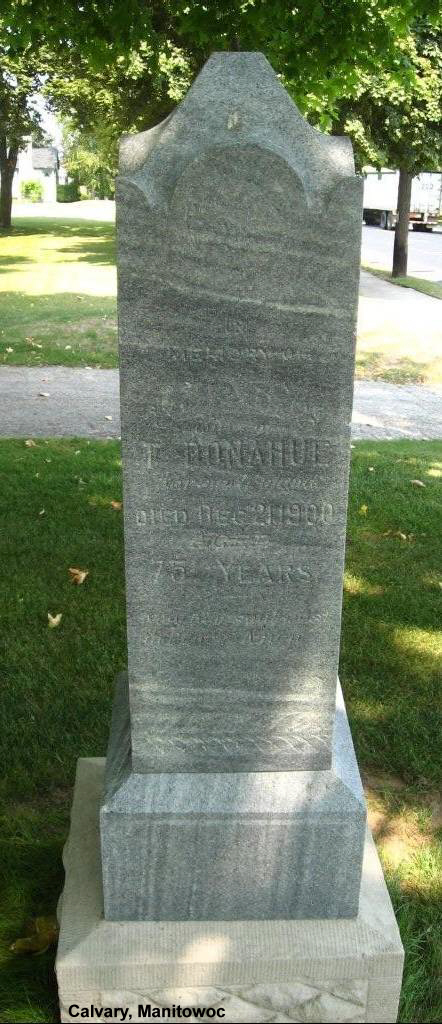
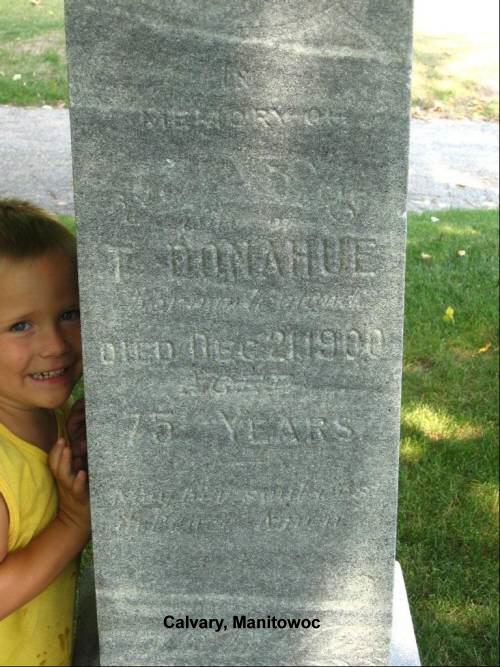
This record deals with what family information has been found on the internet and primarily from one valuable online source for Manitowoc Genealogy, http://www.2manitowoc.com/. This web-page has provided a wealth of information and is probably the best I have encountered regarding our family history. As of now what is reflected here deals with the records regarding the cemetery of St. Isidore’s Catholic Church in Meeme where our grandmother Mary Ellen Donahue was born and raised. Our Great-Grandparents, Thomas and Mary Donahue are not buried in this cemetery however. After selling the Donahue farm near the end of the 19th century they purchased a small home in Manitowoc where they lived out the rest of their lives. They were buried in the Calvary Catholic cemetery in the town of Manitowoc. The web source mentioned here has pictures of the Donahue grave marker posted on their web-page, one of very few pictures they post, and the following links will take you to those pictures. A small boy is captured in one photo and he remains unidentified.

http://www.2manitowoc.com/01/43donahuemary.jpg
http://www.2manitowoc.com/01/43donahuemary2.jpg

When one attempts to gather information on any family of the 1800’s the most accessible and credible source is always the records of the local churches that the ancestors attended. That has proved to be the case for both of our Irish ancestral families, the McGinnis’s of Chatham, New Brunswick and the Donahue’s of Manitowoc County, Wisconsin. In New Brunswick it is St. Michael’s of Chatham and in Wisconsin it is St. Isidore’s of Meeme or Osman. Meeme is where the Donahue home was located for most records and Osman, but a few miles away, is where the church was located. Only the cemetery remains an active part of a new parish near by. The old church and school have apparently been torn down or sold off. The Meeme-Osman area of Manitowoc County is about 15 miles to the southwest of the city of Manitowoc and but 3 miles to the west of Interstate 43 that runs north from Milwaukee to Green Bay, Wisconsin, following the Lake Michigan shore line.


The following short description and photo regarding St. Isidore’s is from the wonderful source mentioned above: http://www.2manitowoc.com/


ST. ISIDORE CATHOLIC CEMETERY

Meeme Township, Manitowoc Co., Wisconsin
Location: Located on the east side of Highway 42 in Osman, directly in back of the church and school. The cemetery is well kept but does have large areas where there are no longer any markers. Copied Saturday and Sunday, August 20 and 21, 1977 by Marcie Baer, a member of the MCOCS. Earliest remaining stone is 1856.


By accessing a list on the Manitowoc web-site that transcribes the names and dates of all the headstones for the St. Isidore’s parish cemetery the Donahue’s of Manitowoc County are represented. Several graves of various ancestral family members are easily identified and can be traced on our family tree. A few other Donahue’s cannot be connected to our line but I strongly suspect that someday a connection might be proven.

Below is the list which appears to be the recorded Grave Transcriptions integrated somehow with actual parish records. The combination of data has led to some discrepancies between the two sources and they are not sorted out here. Actual relationships to our Great-Grandfather Thomas Donahue have been added after collaboration with other Donahue family history researchers. This is a combined effort of me, Molly McGinnis Wright of Dundee, Oregon, Sharon Donahue Moniowczak of Bark River, Michigan and Floyd Billings Jr., of Provo, Utah.

As is common with many ancestral surnames, the Donahue name also emerges from past records with several different spellings. Some variants are “Donaghue with or without the “O” in front, Donahoe or even Donohoe. O’Donaghue appears to be the most common spelling found in many 19th century records originating in Ireland, but not necessarily the original version. Many times the spelling is a clerical error and at other times different families adapted their own choice of spelling after they immigrated. What survives in the records of St. Isidore’s may be attributed to both reasons. We have no definite reasoning to apply to what the records reflect today.

Sharon Donahue Moniowczak and her brother, Richard Donahue, have compiled more extensive Church, Cemetery and even County records that I will attempt to scan and post at a future date. Their effort really needs to be properly recognized and presented as a stand alone posting. They put forth a considerable effort to gather all they did and it is greatly appreciated by the rest of us.

As always, I can only suggest that if you want to make any sense out of all of this that you download a Donahue family tree that I have uploaded and stored on Google Documents. That tree can be found at the following link but you will need to log into Google to view it-
http://docs.google.com/fileview?id=F.2d2eb78f-c53a-4948-b2eb-22fda413d199&hl=en&pli=1

One abbreviation might need explaining, i.e. “OSSW” has the meaning “On the same stone with”.


Michael Donahue-
Grave Transcription-
Michael, Son of, T.& M.A. Donahoe, Born, Sept. 20, 1885, Died Febr. 16, 1886,
Budded on earth, in bloom in heaven., ossw: 1885-1886

Relationship to Thomas Donahue Sr.:
Grandson of Thomas Donahue Sr. and Mary McKeough Donahue, son of Thomas Donahue Jr.

For my generation, this would be a son of our Grand-Uncle, Thomas Donahue Jr. Relationship tables do not actually assign a relationship of the son to my current generation. The tables stop assigning at the level of the father of this Michael Donahue.

Thomas Donahue-
Grave Transcription-
Thomas Donahoe, Born June 9, 1857, Died, March 14, 1887 (War vet flag holder)
Footstone: T.D.
1857-1887

The Church Record for the burial states:
Thomas Donahue, no stone, d. 14 Mar. 1887, age 29 yrs., husband of Maria Anna Donahue (from records of St. Isidore Cath. ch. bk.1 p.201)

Relationship to Thomas Donahue Sr.:
Son of Thomas and Mary McKeough Donahue and an older brother of our Grandmother, Mary Ellen.
This is the father of Michael Donahue as explained in the first Grave Transcription above and a Granduncle to today’s generation.


Patrick Donahue-
Grave Transcription-
Patrick Donahue, ossw: Wife, Honorah

The Church Record for the burial states:
Patrick Donahue, d. 9 Jan. 1917, age 88 yrs, (from records of St. Isidore Cath. ch. bk.1 p.220)

Relationship to Thomas Donahue Sr.:
Brother. Brother Patrick emigrated from Ireland in the mid-1850’s after his brother Thomas had begun farming. Most likely Thomas promoted if not financed his younger brother to help him immigrate and begin his life of farming nearby.

Hanorah Donahue-
Grave Transcription-
Hanorah, wife of P. Donahue, Died June 20, 1896, Aged 63 years, a native of Roscommon Ire., ossw: Husband, Patrick1833-1896


The Church Record for the burial states:
Hanora Donahue, d. 22 June 1896 (from records of St. Isidore Cath. ch. bk.1 p.206)

Relationship to Thomas Donahue Sr.:
Sister-in-law, wife of Brother Patrick.

Hanorah’s maiden name was Luby. She married Patrick Donahue about 1858 in Manitowoc County. No trace of her family line has been found to date. She also was an immigrant from Roscommon in Ireland, an area just to the north of Galway where the Donahue’s originated.

John Donahue-
Grave Transcription-
John, Son of, Patrick & Honorah, Donahue, Died, June 23, 1897, Age 34 years.
1862 or 1863-1897

The Church Record for the burial states:
John Donahue, d. 25 June 1897, age 30 yrs (from records of St. Isidore Cath. ch. bk.1 p.207)

Relationship to Thomas Donahue Sr.:
Nephew, son of Brother Patrick and Hanorah.

To the current generation this is a “first cousin, twice removed”. Removed in essence only indicates the individual was of another generation. Our cousin Tommie of Florence is a first cousin once removed. I constantly have to refer to the following definition each time I come across the relationship in our family data.


Patrick Donahue-

The Church Record for the burial of Patrick Donahue provides the following:
Patrick Donahue, d. 7 Dec. 1899, age 22 yrs, par. John Donahue and Margaret Fitzgerald (from records of St. Isidore Cath. ch. bk.1 p.209)
1877-1899

The following notation was inserted into the internet list. It was taken from a local German language newspaper. The Irish and the German farmers of the region lived side by side and the families intermarried as in the case of Margaret Donahue, our Grandmother’s sister that married an Arnold Siehrs. They preserved their separate cultures but in essence they were all proud members of the local community.

From Der Nord Westen, 14 Dec. 1899:

Patrick Donahue of Meeme, who was working in a lumber camp near Menominee, Michigan on Thurs. last week, was hit by a falling tree and killed. His body was brought to Meeme for burial. He was 22-1/2 yrs. old.

Relationship to Thomas Donahue Sr.:
Grandson, son of John Donahue-
To the current generation, he also would be a first cousin, once removed.

Removed-

When the word "removed" is used to describe a relationship, it indicates that the two people are from different generations. You and your first cousins are in the same generation (two generations younger than your grandparents), so the word "removed" is not used to describe your relationship.

The term "once removed" mean that there is a difference of one generation. For example, your mother's first cousin is your first cousin, once removed. This is because your mother's first cousin is one generation younger than your grandparents and you are two generations younger than your grandparents. This one-generation difference equals "once removed."

Twice removed means that there is a two-generation difference. You are two generations younger than a first cousin of your grandmother, so you and your grandmother's first cousin are first cousins, twice removed.

John Donahue-

The Church Record for the burial of John Donahue states:
John Donahue, no stone, d. 1 Oct. 1912, age 62 (from records of St. Isidore Cath. ch. bk.1 p.217)
1850-1912

Relationship to Thomas Donahue Sr.:
Son of Thomas and Mary McKeough Donahue.
A Granduncle to today’s generation.

One of the few if not the only child of Thomas and Mary that lived his life out in the Meeme or Osman areas.

Ida Donahue-
The Church Record for the burial of Ida states:
Ida Donahue, no stone, d. 18 July 1911, age 20 yrs, par. John Donahue and Margaret Fitzgerald, from records of St. Isidore Cath. ch. bk.1 p.216)
1881-1911

Relationship to Thomas Donahue Sr.:
Granddaughter, daughter of John Donahue and Margaret Fitzgerald

William Donahue-
The Church Record for the burial of William Donahue states:
William Donahue, no stone, d. 30 Nov. 1906, age 19 yrs (from records of St. Isidore Cath. ch. bk.1 p.213)
1887-1906

Relationship to Thomas Donahue Sr.:
Grandson, son of John Donahue


The Donohue’s within the record that follow appear not to be related. Molly McGinnis has a very curious mind and is very good at bringing up possibilities and some of her notations are included here for future reference.

Donahue-
Grave Transcription-
Mary Donohue, daughter of, Patrick & Mary HAYES, and wife of Michael Donohue, Born March 20, 1818, Died Oct. 7, 1876, ossw: 1818-1876

Relationship to Thomas Donahue Sr.:
Unknown relationship. Most likely not related.

Molly’s comment:

Another puzzle. In 1860 in Meeme, there’s a Charles & Margaret in their household as: John Hayes, Michael Donahue (age 50 born Ire), Jeremiah Donahue (age 15 born Ire), and Mary Donahue (age 8 born Pennsylvania). It’s interesting that a John Hayes is listed as he could be a brother-in-law to this Michael Donahue if he’s the Michael married to Mary. However, the only Mary listed is an 8 year old. Notice again, that young Mary was born in Pennsylvania as the earliest Jeremiah Donahue children were. This is looked like a good possibility as John Hayes is listed and supposedly Mary Donohue was the daughter of Patrick & Mary Hayes—they may have been siblings. But where’s Mary born 1818? Could they have not gotten married until after 1860? Perhaps this Michael had been a widower?

Another possibility, is in 1870 in Plymouth, Sheboygan Co. There’s a Michael born 1807 Ire, Mary born 1820 Ire, along with a Mary 16, Patrick 14 and Dennis 12. Since the Jeremiah group was in Sheboygan Co, there may be a connection there, too. Hope Floyd has some input for this one.

My comment:
When Brother Patrick arrived from Ireland, he undoubtedly traveled with another sibling, Mary Donahue. Mary appears in the records at about the same time that Patrick does suggesting the older brother Thomas may have provided the means for both of his siblings to immigrate. Perhaps there were other family members in Ireland that did not come to the U.S. leaving the possibility that we may have relatives in Ireland even today. That remains to be proven.


Mary Donahue, again, a sister of our Great-Grandfather, married one Arnold Siehrs as mentioned earlier. The next five descriptions are of Mary’s family. The children of Mary and Arnold of course would be distant cousins to our current generation.

Arnold Siehrs-
Grave Transcription-
Arnold Siehrs, Dec. 25, 1866, Apr.8, 1939
1866-1939

Relationship to Thomas Donahue Sr.:
Nephew, son of Mary Donahue Siehrs and husband Arnold

Mary Siehrs-
Grave Transcription-
Mary Siehrs, Dec. 25, 1819, Apr. 30, 1915, next to Large Siehrs monument,
1819-1915

Relationship to Thomas Donahue Sr.:
Sister, Mary Donahue Siehrs.
Also next to Large Siehrs monument


Arnold Siehrs-

Grave Transcription-
Arnold Siehrs, Dec. 13, 1817, Jan. 3, 1896, next to:
1817-1896

The Church Record for the burial states:
Arnold Siehrs, d. 6 Jan. 1896, age 73 yrs. (from records of St. Isidore Cath. ch. bk.1 p.206)

Relationship to Thomas Donahue Sr.:
Brother-In-Law , Husband of sister Mary Donahue Siehrs
John Siehrs-
Grave Transcription-
John, Sept. 26, 1863, Oct. 13, 1934,ossw:
1863-1934

John Siehrs-

Grave Transcription-
John, Sept. 26, 1863, Oct. 13, 1934,ossw:

1863-1934

Relationship to Thomas Donahue Sr.:
Nephew, son of Mary Donahue Siehrs and husband Arnold.

Catherine Siehrs-
Grave Transcription-
Catherine, July 31, 1873, May 12, 1941
1873-1941

Relationship to Thomas Donahue Sr.:
Wife of Nephew, John Siehrs


Donahue’s- Related or not ?

Another Donahue Family is at rest in St. Isidore's and collaboration with others results in no connection to our Donahue’s. Some comments that passed between us while attempting to sort all this out are included here.

Family Marker Description-
Large stone-family name only. Separate stones read:

Katherine, 1856-1928, next to:
Nellie, Apr. 9, 1865, Apr. 23, 1913, next to:
Katharine, Sept. 15, 1819, Oct. 6, 1897, next to:
Jeremiah, Jan. 6, 1822, Dec. 20, 1909

Relationship of this family to Thomas Donahue Sr.:
Unknown, if any

Molly’s comment:
This is Jeremiah & Catherine Donahue with two of their daughters. Again, how are they connected to Thomas?

Floyd’s input:

This refers to a family that lived mostly in Sheboygan County. Much information about them is available in the Sheboygan county website. The mother's maiden name was Hayes and that is presumably what made for a connection to St. Isidore.

Church Records reveal the following detail of the family:
Jeremia Donahue, d. 23 Dec. 1909 (was buried at St. Michaels, Mitchell, Wis. moved to St. Isidore Cemetery, 3 Oct. 1911 (from records of St. Isidore Cath. ch. bk.1 p.216)
1822-1909

Molly’s comment:

Jeremiah Donahue was the husband of Catherine Donahue listed in #11. I’m hoping that Floyd has the connection to Thomas, if there is one to be had. Jeremiah & Catherine are in Plymouth, Sheboygan Co. in 1860; Greenbush, Sheboygan Co. in 1870; Mitchell, Sheboygan Co. 1880, 1895; & Jeremiah is living with son, Bart (Bartholomew) in 1900 also in Mitchell. Jeremiah immigrated in 1846 and was born in Ireland in Jan 1822 according to the 1900 census. Remember Floyd sent us a copy of a photo of one of his family with “relatives in Sheboygan”. Could these relatives possibly be connected to the Jeremiah Donahue family? Jeremiah & Catherine had a whole slew of kids: Johanna, Timothy, Eliza,

Catherine Donahue, d. 8 Oct. 1897, age 78 yrs (from records of St. Isidore Cath. ch. bk.1 p.207)
1819-1897

Helena (Nellie) Donahue, d. 23 Apr. 1913, age 47 yrs, from records of St. Isidore Cath. ch. bk.1 p.218)
1866-1913

Another different family:

Grave Transcription-

Mikey, son of Cors & Mary Donohoe, Born Sept. 25, 1863, Died Aug.17, 1873
1863-1873
:

Relationship to Thomas Donahue Sr.
Unknown, if any

Floyd’s input:

Mikey is presumably a son of Cornelius & Mary Donahue who lived in Manitowoc 3rd ward for a short time around 1880. Cornelius was a railroad engineer.